Introduction
Every branded corporate gift acts as a walking billboard for your business—each time a client uses that custom tumbler or wears that embroidered jacket, your logo reinforces the relationship. Research from PPAI confirms this impact: 90% of recipients report improved brand perception after receiving a promotional product, and 79% are more likely to do business with the brand. That impression, though, lives or dies on execution quality — a faded logo or misaligned print actively damages the brand perception these gifts were meant to build.
Businesses face dozens of tool options across multiple categories: design software, laser engravers, sublimation printers, embroidery machines, and full-service platforms. Balancing quality, scale, and budget is genuinely difficult — and 67% of print production errors trace back to prepress issues like incorrect file formats or color conversions before a single item is produced.
Knowing which tools prevent those errors — and which match your workflow — is the real decision. This guide covers the five most important tool categories for creating branded corporate gifts, who each is best suited for, and how to choose the right fit based on your order volume, gift type, and production setup.
TLDR
- Logo design and proofing software prevents costly errors with vector files and precise color management
- Laser engravers deliver permanent, premium branding on hard goods like leather, wood, and metal tumblers
- Sublimation printers and heat presses create vibrant, wash-resistant designs on drinkware and polyester apparel
- Embroidery machines remain the gold standard for high-value fabric gifts, offering durable 3D texture
- Full-service promotional suppliers eliminate equipment overhead and handle diverse product categories under one roof
Why the Right Tools Matter for Branded Corporate Gifts
Branded corporate gifts are items bearing a company's logo, colors, or tagline—applied through printing, engraving, or embroidery—that turn everyday items into lasting brand touchpoints. Unlike generic gifts, a well-branded item keeps your name in front of clients long after the meeting ends.
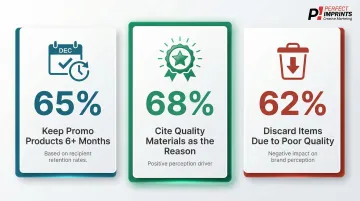
Tool quality directly determines gift quality. Nearly 65% of consumers keep promotional products for six months or longer, with 68% citing high-quality materials as the primary reason. Conversely, 62% of discarded items are thrown away due to poor material or build quality—which actively harms brand perception rather than enhancing it.
The right tools let businesses produce gifts that hold up visually whether you're ordering 10 units or 10,000—and that difference is what separates a gift that builds goodwill from one that ends up in a drawer.
The Best Tools for Creating Branded Corporate Gifts
These tool categories were selected based on versatility across gift types, branding output quality, scalability, and accessibility for businesses of varying sizes—from in-house production setups to fully outsourced programs.
Logo Design and Digital Proofing Software
Before any physical production begins, every branded gift starts with digital design. Logo design software like Adobe Illustrator, CorelDRAW, and Canva allows teams to create print-ready artwork, specifically vector files (.AI, .EPS, .PDF) that scale infinitely without losing clarity, with color profiles (Pantone/CMYK) and resolution specifications matched to each production method.
Digital proofing tools like Adobe Photoshop, Figma, or InVision let you visualize how your logo will actually appear on a specific product before committing to production. This prevents costly reprints and ensures brand consistency across different gift surfaces. Industry data shows that 67% of print production errors trace back to prepress issues, with mid-sized shops losing $2,000-$4,000 monthly in rework costs.
Critical file requirements:
- Submit logos in vector formats only—raster images (pixels) lose quality when scaled
- Convert all text to outlines/paths to prevent font substitution errors
- Use Pantone spot colors for exact brand matching or CMYK for full-color printing
- Never submit RGB files—they shift colors unpredictably when converted for physical printing
| Criteria | Details |
|---|---|
| Best For | Creating and refining brand artwork; generating production-ready files; approving designs before bulk orders |
| Key Features | Vector editing, color mode control (CMYK/Pantone), mockup generation, design collaboration |
| Considerations | Adobe products require subscription fees; Canva is accessible but limited for complex print work; always export in the format required by your production vendor |
Laser Engraving and Cutting Machines
Laser engravers and cutters (Glowforge, xTool, Epilog) are the go-to tool for adding precise, permanent branding to hard goods, including leather, wood, metal, acrylic, and glass. Laser engraving etches logos and text directly into the material surface, producing a premium finish that doesn't fade, peel, or wear off.
CO2 vs. Fiber lasers — know the difference:
- CO2 lasers excel at organic materials (wood, acrylic, leather, glass) but cannot cut metal
- Fiber/MOPA lasers specialize in metals (stainless steel, aluminum, brass, titanium) with deep engraving and 3D embossing capabilities
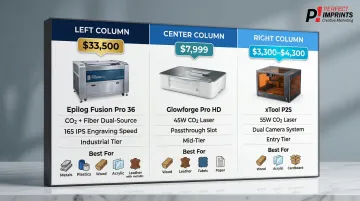
The business case: laser engravers suit companies with in-house customization needs and recurring gift programs. They require upfront investment ($3,300-$33,500 depending on model) but offer per-unit cost efficiency at scale and support a wide range of branded gift items, including journals, tumblers, USB drives, keychains, and award plaques.
Equipment comparison:
- Epilog Fusion Pro 36 (~$33,500): Industrial dual-source (CO2 + Fiber), 165 IPS speed, handles both organic materials and bare metals
- Glowforge Pro HD ($7,999): 45W CO2, Pro Passthrough for oversized items, live camera alignment
- xTool P2S ($3,300-$4,300): 55W CO2, dual smart cameras, cuts 18mm basswood, Class 1 safety certification
| Criteria | Details |
|---|---|
| Best For | Hard goods: leather items, wooden products, metal tumblers, glass awards, tech accessories |
| Key Features | High precision, permanent marking, compatible with multiple materials, scalable for batch production |
| Considerations | Upfront equipment cost; requires design software integration; learning curve for setup and material calibration; mandatory ventilation/fume extraction |
Sublimation Printers and Heat Press Machines
Sublimation printing (Sawgrass Virtuoso, Epson EcoTank with sublimation ink) is the best method for full-color, photographic-quality branding on polymer-coated hard goods (mugs, tumblers, phone cases, mouse pads) and polyester-based apparel. The dye bonds with the material at a molecular level, producing vibrant, wash-resistant results with no cracking or peeling.
Critical material constraints:
- Sublimation only works on 100% polyester fabrics or polymer-coated hard substrates
- Requires white or light-colored bases for accurate color reproduction
- Cannot be used on 100% cotton or dark fabrics
Heat press machines (Cricut EasyPress, PowerPress) complement sublimation and enable heat transfer vinyl (HTV) applications on t-shirts, caps, tote bags, and jackets, making them essential for branded apparel and soft-goods gift programs.
Entry-to-mid-range commercial printers:
- Epson SureColor F570 ($2,825-$2,875): 24-inch roll/sheet capacity, high-volume apparel and rigid media
- Sawgrass SG1000 (~$1,500): 11"x17" format, mid-volume mugs and photo panels
- Sawgrass SG500 ($599.95): 8.5"x14" desktop, entry-level mugs and small gifts
- Epson F170 ($399-$499): 8.5"x11", low-cost entry for small promotional items
| Criteria | Details |
|---|---|
| Best For | Drinkware, apparel, caps, tote bags, mouse pads, and any polymer-coated or polyester-based promotional product |
| Key Features | Full-color output, wash-resistant finish (ISO 105 C06 standards), fast production turnaround for small batches |
| Considerations | Only works on white or light-colored substrates and polyester materials; sublimation requires specific paper and ink; heat press requires consistent temperature calibration |
Embroidery Machines
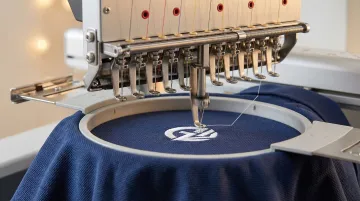
Embroidery machines (Brother PE800, Janome Memory Craft) are the premium standard for logo application on high-quality fabric gifts, including polo shirts, jackets, hats, tote bags, and branded blankets. Embroidered logos convey quality and professionalism through durable, 3D tactile texture that screen printing or iron-on transfers cannot match, making them ideal for executive-level and client-facing branded apparel gifts.
Commercial machine options:
- Brother PR680W ($12,999): 6-needle, 8"x12" embroidery area, wireless connectivity
- Brother PR1055X ($2,499-$3,199): 10-needle for maximum efficiency
- Janome MB-7 ($5,999): 7-needle, 800 SPM speed
- Janome MB-4S ($4,999): 4-needle, compatible with industry-standard Tajima hoops
The digitizing requirement: Embroidery requires converting artwork into stitch-path files (.DST or .PES formats), which adds setup time and cost. Professional digitizing costs $10-$45 per logo depending on complexity, but pays off for recurring programs where the same logo is reproduced consistently across large quantities.
| Criteria | Details |
|---|---|
| Best For | Polos, jackets, hats, tote bags, branded apparel for employee recognition or client gifting |
| Key Features | Durable, high-quality finish; professional appearance; suitable for thick fabrics and structured items; wash-fast durability |
| Considerations | Higher setup cost for digitizing artwork; not ideal for complex photographic designs; best for logos with clean lines and limited color counts |
Online Corporate Gift Platforms and Full-Service Promotional Suppliers
For businesses without in-house equipment, platforms like Vistaprint, Printful, and Swag.com let companies upload logos, choose products, and place branded gift orders directly. Full-service promotional suppliers go further, handling product sourcing, design, production, and shipping under one roof. The promotional products industry reached $27.1 billion in 2025, with online sales at $7.1 billion (26.3% of total revenue), and enterprise gifting platforms continuing to expand: Stran & Company reported 40.6% year-over-year revenue growth driven by online fulfillment services.
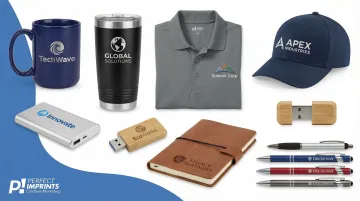
Perfect Imprints operates as a full-service promotional products supplier, covering categories from screen-printed apparel and custom drinkware to promotional bags, tech accessories, and branded office supplies. Clients in healthcare, banking, nonprofits, real estate, and education use Perfect Imprints to consolidate sourcing, design proofing, and fulfillment without maintaining any production equipment in-house.
When to choose full-service suppliers:
- Your order volumes are variable or seasonal (holiday gifting, annual events)
- You need access to diverse product categories without buying specialized equipment for each
- You lack dedicated staff to operate and maintain production equipment
- You want design support and digital proofing before production
| Criteria | Details |
|---|---|
| Best For | Businesses of any size seeking professional-quality branded gifts without in-house production equipment; ideal for bulk orders and multi-category gifting programs |
| Key Features | Wide product selection, logo upload and design support, bulk pricing, managed production and shipping, free digital proofs |
| Considerations | Less control over production process compared to in-house tools; lead times vary by supplier; quality differs significantly between budget platforms and full-service suppliers — vet vendors using QCA (Quality Certification Alliance) standards and CPSC compliance |
How to Choose the Right Tool for Your Corporate Gifting Program
Start with Gift Type and Material
Different tools excel on different substrates—matching tool to material is the most critical first decision:
- Laser engravers: Hard goods (wood, leather, metal, glass, acrylic)
- Sublimation/heat press: Soft goods, polyester apparel, polymer-coated drinkware
- Embroidery: Structured apparel (polos, jackets, hats, heavy textiles)
- Screen printing / online platforms: Versatile across most materials and decoration needs
Material-method compatibility is non-negotiable. Attempting to sublimate 100% cotton or laser-engrave bare metal with a CO2 laser will fail regardless of technique quality.
Factor in Order Volume and Frequency
In-house equipment makes economic sense for businesses that produce branded gifts regularly and in consistent quantities. A true Total Cost of Ownership (TCO) model must account for equipment leases, service contracts, consumables (ink, thread, laser tubes), facility space, and labor—mid-sized shops can spend $12,000-$15,000 monthly just on staffing and backup coverage.
Volume decision framework:
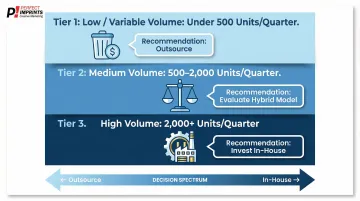
- Low/variable volume (under 500 units/quarter): Outsource to full-service suppliers—avoid equipment costs, maintenance, and learning curve
- Medium volume (500-2,000 units/quarter): Evaluate break-even point; consider outsourcing with occasional in-house for rush orders
- High volume (2,000+ units/quarter): In-house equipment investment justified if baseline monthly volumes guarantee equipment utilization
One-time campaigns, seasonal runs, and varied gift assortments are almost always better served by outsourcing—the flexibility and zero capital cost outweigh any per-unit savings from in-house production.
Evaluate Branding Complexity and Finish Quality Requirements
A simple one-color logo on a tote bag has different tool requirements than a photographic print on a mug. Match the tool's output capability to the finish quality your brand standards demand:
- Simple 1-2 color logos: Screen printing, laser engraving, or embroidery work well
- Full-color photographic designs: Sublimation or digital printing required
- Premium tactile finish: Embroidery delivers the highest perceived value
- Permanent, wear-resistant branding: Laser engraving or embroidery outlast printed methods
Conclusion
Branded corporate gifts are only as effective as the craftsmanship behind them—the right tool ensures your logo lands the way it was designed to, on the right product, at the right scale. Whether you invest in in-house equipment or partner with a full-service supplier depends on your gifting program's volume, variety, and frequency.
Assess your program realistically: businesses with recurring, high-volume needs may justify equipment investment, while those with seasonal or one-off programs benefit from outsourcing to access diverse capabilities without the overhead.
Quality should never be the compromise. 90% of recipients say receiving a promotional product improves their perception of the brand—but only when that product reflects the professionalism your brand represents.
Perfect Imprints handles custom promotional products and branded corporate gifts from art to delivery. Call +1 850-200-4020 to get started.
Frequently Asked Questions
What are the best corporate gifts to give clients?
The best client gifts combine practical utility with professional branding. Top categories include branded drinkware (tumblers, mugs), tech accessories (power banks, USB drives), premium apparel (polos, jackets), and custom office supplies. T-shirts, drinkware, and polos account for 35.8% of industry sales, though premium items like fleece, food gifts, and blankets generate the most excitement.
What is the 4 gift rule?
The 4 gift rule covers something they want, something they need, something to wear, and something to read. Businesses apply this framework to build branded corporate gift sets that feel personal rather than generic—pairing items like a custom tumbler, polo shirt, journal, and tech accessory.
What is the 6 gift rule?
The 6 gift rule extends the 4 gift rule by adding something to experience and something to share or donate. Corporations use it to make bulk gifting feel more curated—for instance, including event tickets or charitable donation cards alongside traditional branded merchandise.
What makes a corporate gift "branded"?
A branded corporate gift includes a company's logo, colors, tagline, or other identifiers applied directly to the product through printing, engraving, embroidery, or sublimation—turning a useful item into a lasting marketing asset.
How far in advance should I order branded corporate gifts?
Most custom orders require 4-6 weeks to allow time for design approval, production, and shipping. Holiday and year-end gifting seasons require even longer lead times—industry best practices recommend finalizing Q4 orders in August and shipping 1-2 weeks before the intended delivery date to avoid exorbitant rush fees and carrier delays.
Can I get branded corporate gifts without minimum order quantities?
Some online platforms and full-service suppliers offer no-minimum or low-minimum options for branded gifts, though per-unit costs are typically lower at higher quantities. For example, promotional candy items may start at 500-unit minimums, while premium blankets can begin at just 8 units. Always confirm minimums and setup fees before ordering.