Apr 3, 2026
How to Leverage a Trade Show for Your Product Launch
Introduction
Trade shows offer one of the most concentrated opportunities to launch a product: buyers, press, and decision-makers who came specifically to discover what's next in your industry. With 81-84% of attendees holding purchasing authority and 92% actively seeking new products, the audience density is unmatched.
But results vary dramatically based on execution. Many brands leave with little to show because they treated attendance as optional rather than strategic. The difference between a forgettable booth and a launch that drives pipeline comes down to planning, promotion, and follow-through.
Key Takeaways
- Pick events where your buyer persona actually attends, then set measurable launch goals before registration.
- Pre-show promotion drives booth traffic—76% of attendees arrive with a pre-planned agenda.
- Design your booth around the product: coordinated reveal, live demo, and branded materials.
- Real-time lead qualification determines whether the launch converts to revenue.
- Follow up within 48-72 hours; response speed directly determines conversion rates.
Pre-Show Planning
Your launch outcomes are determined long before the show floor opens. This phase separates brands that generate buzz from those that build actual pipeline.
Define Launch Objectives First
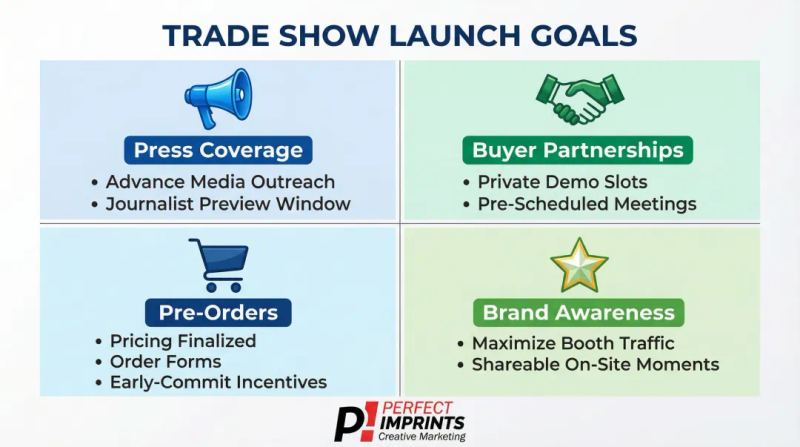
Identify whether you're targeting press coverage, retail buyer partnerships, pre-orders, or brand awareness. Each goal shapes a different strategy:
- Pursue press coverage by scheduling advance media outreach and a dedicated journalist preview window
- Win buyer partnerships by booking private demo slots and pre-scheduling meetings before the show
- Drive pre-orders by finalizing pricing, preparing order forms, and building in early-commit incentives
- Build brand awareness by maximizing booth traffic volume and creating shareable on-site moments
Attach 2-3 measurable metrics to each goal (e.g., 150 qualified leads captured, 10 buyer meetings booked, 5 press mentions secured).
Select the Right Trade Show
Evaluate events based on attendee demographics, not just industry alignment. Research:
- Past attendee counts and job titles
- Competitor presence and booth locations
- Media coverage history
- Innovation stages or dedicated product launch features
A smaller, well-targeted event often outperforms a massive show with diluted audience fit. Match the event's buyer persona to yours.
Build a Pre-Show Campaign (4-6 Weeks Out)
Research shows 90% of attendees pre-plan their booth visits, and 76% arrive with a set agenda. Your job is to get on that list.
Campaign components:
- Send save-the-dates to existing contacts with your booth number and a preview teaser
- Post social teasers using the event hashtag to build anticipation ahead of the show
- Pitch attending journalists with exclusive product preview offers before they finalize their schedules
- Create a dedicated landing page with launch details, press kit downloads, and a meeting scheduler
Pre-show promotions improve audience quality by 46% compared to relying on floor traffic alone.
Prepare Materials in Advance
Avoid last-minute scrambles by finalizing:
- Assemble booth display assets — banners, signage, and product stands.
- Build a digital press kit with high-res images, spec sheets, and your brand story.
- Test your product demo setup and pack backup equipment.
- Set up lead capture tools — badge scanners or CRM-linked tablets work well.
- Source branded promotional items that reinforce the launch theme — custom tote bags, logo tech accessories, and personalized drinkware are popular options that travel well.
Perfect Imprints offers logo-imprinted versions of all three — useful if you need bulk quantities with consistent branding across your giveaway items.
At-Show Execution
The show floor is where planning meets performance. Every detail of your booth, staff behavior, and launch timing must align.
Design Your Booth Around the Product
Place the product at the center of your display. Use:
- Backlighting or spotlighting to draw attention from across the aisle
- Demo stations with clear sightlines so passersby can watch without committing
- Signage that communicates the core value proposition in under five seconds
Booth placement matters—locations near entrances, main aisles, and high-traffic zones dramatically increase organic visibility. Corner booths and intersections offer multiple approach angles. Early registration typically secures better placement.
Coordinate a Launch Moment
A planned, timed reveal creates urgency and social shareability. Options include:
- Live reveal at a specific time, promoted on social and signage
- VIP press preview before the floor opens to general attendees
- Scheduled demo with countdown signage to build anticipation
Coordinated launch moments drive real-time social media posts and press attention. For example, Topgolf's launch event generated nearly 500 organic influencer posts within 24 hours.
Equip Booth Staff Properly
Assign specific roles before the event:
- Product demo specialist handles technical questions and live demonstrations
- Lead qualifier conducts discovery conversations and captures contact details
- Media point of contact manages press inquiries and interview requests
Use a two-tier lead capture approach:
- Quick badge scans for general interest (name, company, email)
- Deeper conversations flagged for priority follow-up with notes on specific needs
Train every team member on product messaging, FAQs, and how to handle different visitor types (press, buyers, casual browsers). That staff preparation also shapes how visitors remember you after they leave the booth—which is where branded giveaways become a strategic asset.
Offer Strategic Branded Giveaways
Promotional products serve as physical memory triggers that extend your launch beyond the event. 83% of consumers recall at least one brand from a promotional product they received.
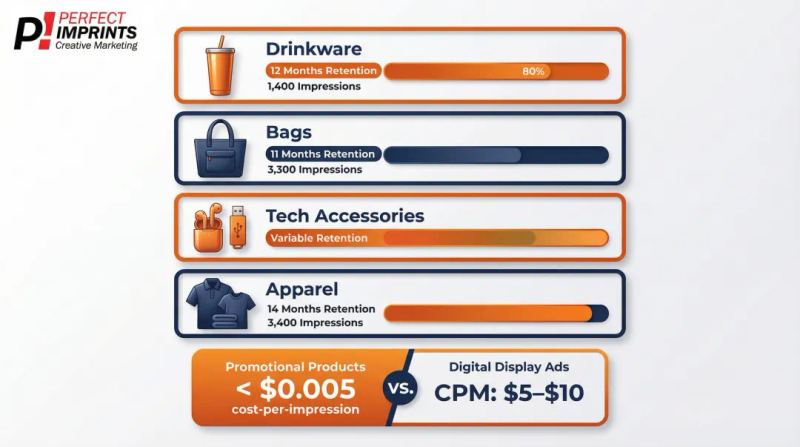
High-retention items include:
- Drinkware (12-month average retention, 1,400 impressions)
- Bags (11-month retention, 3,300 impressions)
- Tech accessories (power banks, USB drives, Bluetooth speakers)
- Apparel (T-shirts: 14-month retention, 3,400 impressions)
These items deliver cost-per-impression rates under 1/2 of a cent—compared to $5–$10 CPM for digital display ads. Choosing items your audience will actually use (not just pocket and forget) maximizes that return well after the show ends. Perfect Imprints specializes in custom-branded drinkware, bags, and tech accessories built for trade show volume, with options like laser engraving and full-color digital printing to match your launch branding.
Post-Show Follow-Up
Most trade show leads go cold within days. How quickly and personally you follow up determines whether your launch momentum turns into actual sales.
Send Personalized Follow-Up Within 48-72 Hours
Conversion rates are 8X higher when responding within five minutes versus waiting longer. While five minutes isn't realistic post-show, 48-72 hours is the outer limit before leads go cold.
Segment contacts by type:
- Press: Thank them for coverage, offer additional assets or interviews
- Buyers: Reference specific conversation points, propose next steps
- End users: Share product details, pricing, and purchase options
- Partners: Outline partnership opportunities and schedule follow-up calls
In each message, reference the specific conversation from the booth. That one detail shows you were paying attention — and sets your follow-up apart from generic post-show email blasts.
Repurpose the Launch Experience
Extend the launch momentum with ongoing content:
- Video recap of the reveal moment and booth activity
- Blog posts covering lessons learned and attendee reactions
- Demo clips uploaded to YouTube and social channels
- Post-show landing pages with launch assets for media and investors
This content also gives your sales team something concrete to share during follow-up — a recap video or demo clip can re-engage a contact who visited your booth but hasn't responded yet.
When Should You Launch a Product at a Trade Show?
Not every product belongs at a trade show. The venue works best when your product benefits from in-person demonstration, when your target buyers are concentrated in one industry audience, and when the show has strong media and buyer attendance.
Ideal Scenarios
According to a 2026 UFI industry report, 42% of exhibitors now prefer industry events for product announcements — a figure that has climbed steadily since in-person events resumed. That preference makes sense when the right conditions align.
Launch at a trade show when:
- Your product has tactile or visual appeal that doesn't translate digitally
- You're entering a new market segment and need face-to-face validation
- You're unveiling a major upgrade to existing customers who attend the event
- You're seeking retail or distribution partnerships that require in-person demos
When to Skip the Trade Show Launch
Avoid trade show launches when:
- The product isn't demo-ready or stable enough to withstand public scrutiny
- Your target audience doesn't attend industry shows
- Your budget can't cover the booth experience and promotion needed to stand out.
- The product is purely digital with no visual or interactive element.
A buggy demo or a prototype that can't answer basic questions damages credibility — sometimes permanently with buyers who won't return to your booth next year.
What You Need Before Your Trade Show Product Launch
Preparation determines results. Showing up without these foundations means leads that stall, press that ignores you, and a launch that fades before the show floor closes.
Launch-Ready Product and Clear Objectives
The product must be stable, demonstrable, and ready to represent your brand publicly. Pair this with 2-3 defined, measurable launch goals:
- X leads captured (e.g., 150 qualified leads)
- Y press mentions (e.g., 5 trade publication features)
- Z buyer meetings booked (e.g., 10 partnership discussions)
Budget Allocation
The average U.S. trade show budget in 2023 was $1.36 million, though smaller exhibitors operate on far less. Plan for these cost categories:
| Expense Category | % of Budget |
|---|---|
| Booth Space | 23% |
| Show Services | 18% |
| Exhibit Design & Construction | 16% |
| Shipping | 11% |
| Travel & Lodging | 11% |
| Marketing Promotions | 8% |
| Graphic Design & Production | 6% |
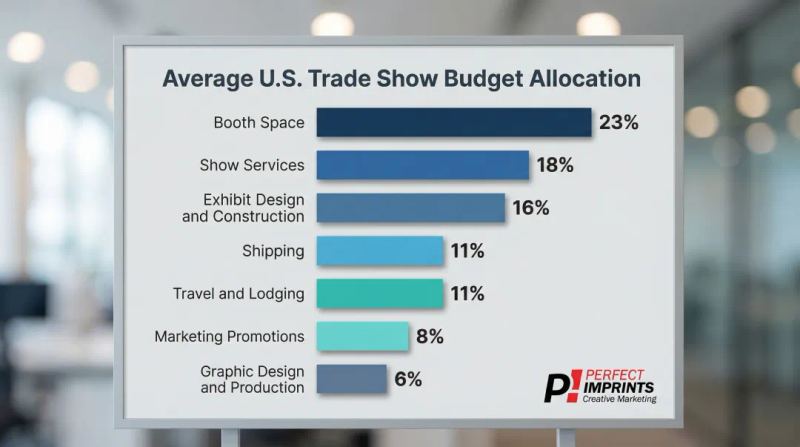
Underfunding any category creates execution gaps. Booth space typically costs $20-40 per square foot, while custom exhibit fabrication ranges from $100-300+ per square foot.
Branded Collateral and Promotional Materials
Prepare a complete set of launch materials:
- Digital press kit: High-res product photos, spec sheets, brand story
- Printed one-pagers or brochures for buyers
- Branded giveaway items tied to the product being launched
All materials should be visually consistent with your booth and pre-show campaign. Perfect Imprints offers trade show displays and branded promotional items — from retractable banners and pop-up tents to custom tote bags and tech accessories — with full-color logo imprinting to keep your brand cohesive across every touchpoint.
Staffed and Briefed Booth Team
Assign specific roles before the event and train every team member on:
- Product messaging and key talking points
- FAQs and objection handling
- Lead qualification framework
- How to handle different visitor types (press, buyers, casual browsers)
Attendees spend an average of 5.5 hours at trade shows, and 68% rate hands-on demonstrations as the most important element. Your team must be prepared to deliver.
Key Factors That Determine Trade Show Launch Success
Not all trade show product launches land the same way. These four factors consistently determine whether a launch breaks through or gets lost in the noise.
Booth Placement and Visibility
High-traffic areas near entrances, main aisles, or anchor exhibitors dramatically increase organic foot traffic without extra promotion spend. Early registration typically secures better placement.
A centrally located booth with visible launch signage can multiply attendee engagement compared to a back-corner setup with identical creative — same product, very different results.
The Launch Moment Itself
A planned, timed, and promoted reveal creates urgency and social shareability. An unannounced product sitting on a table creates none of that energy.
A coordinated launch moment drives press attention and real-time social posts from attendees, amplifying the launch well beyond the booth itself.
Quality and Relevance of Branded Takeaways
Attendees leave every show with bags of giveaways. The items that survive the trip home — and end up on desks — are the ones that are useful, high-quality, or directly tied to the product's story.
A few practical guidelines:
- Prioritize fewer, better items over high volumes of generic ones
- Choose giveaways relevant to your product category or industry
- Avoid items that are immediately disposable (flimsy pens, single-use items)
Promotional products deliver cost-per-impression rates as low as 1/10 of a cent, making them more cost-efficient than digital display ads or direct mail.
Post-Show Follow-Up Speed and Personalization
Trade show leads decay fast. The longer the gap between the show and your outreach, the more context and urgency evaporates.
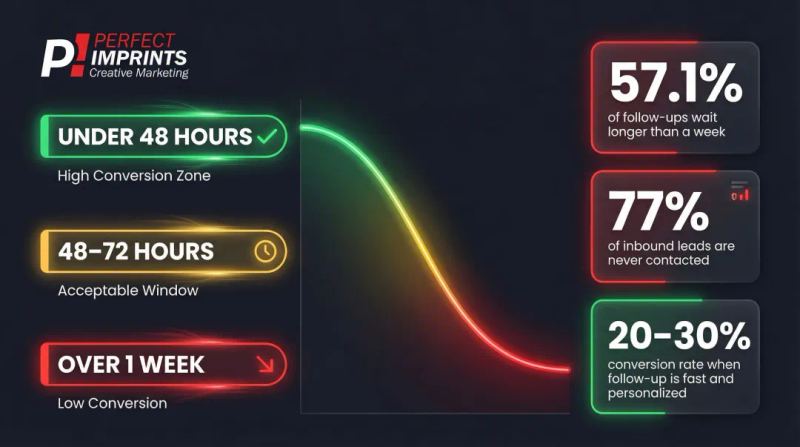
Conversion rates drop sharply with delayed follow-up — 57.1% of all follow-up attempts wait longer than a week, and 77% of inbound leads are never contacted at all. Trade shows can convert 20–30% of leads to sales, but only when follow-up is fast and personalized.
Common Mistakes to Avoid When Launching a Product at a Trade Show
Several common mistakes kill trade show ROI. Avoid these pitfalls:
- No pre-show outreach: Counting only on floor traffic means competing just with booth looks. Without advance outreach to press, buyers, and your network, you're not drawing a prepared audience — you're hoping one wanders over.
- Launching a product that isn't demo-ready: If staff can't confidently demonstrate or explain the product under pressure, buyers will move on. Trade shows aren't the right place for beta-stage products unless that's explicitly your framing.
- Collecting badges without qualifying leads: Skipping conversation notes, interest levels, and next steps turns your lead list into a cold email list. Fewer than 10% of exhibitors use custom qualifiers in their lead retrieval systems, which is why so much captured data goes nowhere.
- Building the follow-up plan after the show: Templates, segmented lists, and assigned lead owners should be ready before you leave for the event. At least 40% of trade show leads go completely unfulfilled — usually because no one was set up to act on them.
Frequently Asked Questions
A general product launch framework includes market research, goal setting, positioning, pre-launch promotion, launch execution, lead capture, and post-launch follow-up. A trade show compresses all these phases into a single concentrated event, accelerating feedback and results across every stage.
Core announcement channels include a press release distributed to trade media, an email campaign to your existing contact list, a social media teaser campaign using event hashtags, and a coordinated reveal moment at the trade show booth. Using all four together ensures your message reaches attendees before, during, and after the show.
The 4 P's—Product, Price, Place, and Promotion—form the foundation of any marketing mix. At a trade show, the event itself covers both Place and Promotion, while your booth demos and collateral handle Product positioning and Price communication.
A soft launch targets a limited audience with low fanfare to test market response. A hard launch is a full public release with maximum promotion aimed at broad market penetration. A trade show launch targets a high-intent, concentrated audience with live demonstration and press access, ideal for B2B products requiring hands-on evaluation before purchase.
Begin preparation at least 3-4 months out for booth design and materials, 4-6 weeks for pre-show promotion and press outreach, and 1-2 weeks for staff training and final logistics. Pre-show email campaigns should start six to eight weeks before the event to maximize attendee awareness.
Essential components include high-resolution product images, a press release or product announcement, a one-page fact sheet with specs and pricing, brand background information, and a dedicated media contact name and email. Make the press kit available both digitally and in print at your booth.