Apr 3, 2026
Event Planning for Bulk Orders: Q1 2026 Guide
Introduction
Budgets reset on January 1, but production slots fill up weeks before most procurement teams submit their first order. By late January, lead times for branded merchandise routinely stretch past event dates — and rush fees add 20–30% to costs that were never budgeted. According to the Citizens Bank Q1 2026 Business Pulse Survey, 86% of middle-market businesses expect revenue growth this quarter, and 60% plan to increase capital deployment. More organizations are hosting events, and vendor capacity isn't growing to match.
This guide provides a practical Q1 2026 event planning framework specifically for organizations ordering promotional products and branded items in bulk. We'll cover early planning steps, vendor selection, lead times, and budgeting strategies to ensure your branded materials arrive on time without rush fees or quality compromises.
Key Takeaways
- Q1 2026 is event-heavy, so start planning and ordering by November or December 2025 to avoid vendor bottlenecks.
- Custom bulk items need 2–6 weeks for production plus shipping; rush orders add 15–30% in fees.
- Match bulk items to your event type and audience—useful, premium products outperform generic swag.
- Set per-attendee budgets early and use tiered pricing to maximize value.
- Budget 7–14 days for design sign-offs; artwork typically takes 4 revision rounds before approval.
Why Q1 2026 Demands Earlier Event Planning Than You Think
The Q1 Event Crunch
Q1 is one of the busiest event periods for businesses, nonprofits, associations, and government bodies. Annual kick-off meetings, industry conferences, trade shows, and recognition events cluster between January and March. While budgets reset on January 1, planning decisions made in late November and December directly determine whether branded materials arrive on time.
According to Exhibitor Magazine, the majority of marketers begin planning for trade shows 10 to 12 months in advance. Yet many organizations delay merchandise orders until Q1 itself—which triggers rush fees, longer production queues, and fewer customization options when suppliers are at peak capacity.
2026-Specific Context: Tariffs and Supply Chain Pressures
Two compounding factors make Q1 2026 especially risky for last-minute orders:
- Chinese New Year shutdown (beginning February 15–17) adds 4–6 weeks to supply chain timelines, with factory closures lasting 2–4 weeks
- Tariff volatility drove nearly 90% of promotional distributors to raise prices by an average of 11% in 2025, with further uncertainty continuing into 2026
Organizations hosting events between January and March should finalize orders by late November or early December 2025 to lock in current pricing and avoid peak-season delays.
Q1 Event Planning Checklist for Bulk Orders
Before contacting any supplier, lock down five planning inputs. Skipping any one of them creates downstream problems with quantities, timelines, or budget:
- Event purpose and theme — drives messaging and design direction
- Audience size and demographics — sets quantity tiers and product selection
- Vendor and logistics details — determines lead times and shipping windows
- Promotion and messaging plan — defines artwork scope and revision rounds
- Post-event follow-up plan — accounts for leftover inventory and potential reorders
With these confirmed, you're ready to move into the two steps that shape every bulk order decision.
Step 1 – Nail Down Your Attendee Count and Event Type First
Headcount is the single most important input for any bulk order. It determines quantity tiers, per-unit cost, and shipping logistics — and getting it wrong in either direction costs money. Underestimating means last-minute reorders at higher per-unit cost; overestimating leaves you with unused inventory.
Recommended Order Quantity Formula:
(Expected attendees × 1.1–1.15) = recommended order quantity
We build in a 10–15% buffer for no-shows who still receive items, breakage, walkup guests, and staff needs.
Example:
- Expected attendance: 300
- Buffer calculation: 300 × 1.15 = 345 units
- Order quantity: 350 units (rounded to nearest pricing tier)
Step 2 – Map Your Event Timeline Back from the Event Date
Working backward from your event date forces you to account for every stage — and reveals quickly whether your timeline is realistic. Miss one window and you're looking at rush fees or substitutions. Start from your event date and subtract:
| Milestone | Time Required | Notes |
|---|---|---|
| Production lead time | 2–6 weeks | Varies by product category (see table below) |
| Shipping time | 3–7 business days | Standard ground; expedited options cost more |
| Artwork approval time | 3–5 business days | Per proof round; averages 3.9 revisions |
| Quote-gathering time | 1 week | Time to compare suppliers and pricing tiers |
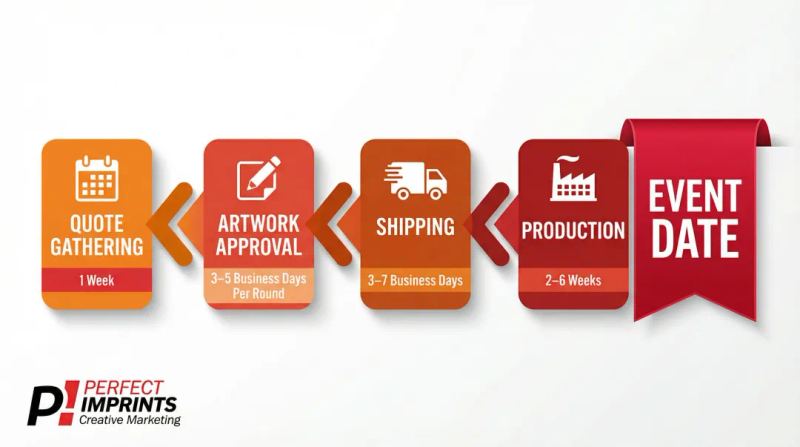
For Q1 events (January–March 2026), order decisions should be finalized by late November or early December 2025. Even March events carry risk if complex custom items are ordered in February.
Best Bulk Promotional Products for Q1 2026 Events
The most effective bulk promotional items match the season (winter or early spring), the event format, and the audience's daily needs. According to PPAI's 2025 research, 68% of consumers keep promotional items strictly because they are useful in daily life. Generic items with low perceived value get tossed quickly.
Top Bulk Items by Event Type
Corporate Conferences and Association Kick-Offs:
- Custom apparel (polo shirts, jackets, hoodies)
- Notebooks and pens — used throughout sessions, not just taken home
- Tote bags for carrying conference materials
- Drinkware: tumblers, water bottles, coffee mugs
Apparel orders need size breakdowns and longer production windows (typically 3–4 weeks minimum), making them one of the first items to order for Q1 events.
Trade Shows and Expos:
- Custom lanyards — high visibility, low cost
- Branded pens, stickers, and keychains for quick giveaways
- Small pouches: practical for booth visitors
These items distribute easily at a booth and are inexpensive enough to order in large quantities (500+ units). For events where attendee tier matters more than volume, the calculus shifts.
Nonprofit Galas, Fundraisers, and Recognition Events:
- Premium drinkware: stainless steel tumblers, engraved glassware
- Branded gift boxes with curated contents
- Custom awards and plaques with lasting recognition value
Quality matters more than quantity at formal events — attendees notice the difference between a thoughtful gift and a throwaway item.
Perfect Imprints carries bulk promotional products across all these categories — apparel, drinkware, bags, tech accessories, and event displays — so event planners can source everything for Q1 from a single supplier.
Ordering Timelines: How Far Ahead to Place Bulk Orders for Q1 Events
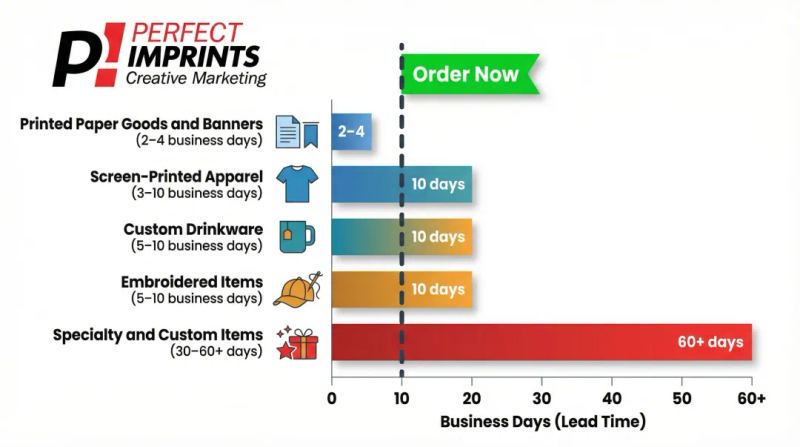
Standard Lead Times by Product Category
| Product Category | Production Lead Time | Notes |
|---|---|---|
| Screen-Printed Apparel | 3–10 business days | Blank apparel ships same-day; decoration adds time |
| Embroidered Items | 5–10 business days | Complex designs may require longer |
| Custom Drinkware | 5–10 business days | Minimum 48–100 units depending on supplier |
| Printed Paper Goods & Banners | 2–4 business days | Rush production available for some items |
| Specialty/Custom Items | 30–60+ days | Highly vulnerable to overseas shipping delays |
The Real Cost of Rush Orders
Ordering late triggers rush surcharges that can significantly inflate your budget:
- CustomInk: 15% fee for 1-Week Rush; 30% fee for Super Rush (3-day delivery)
- Overseas suppliers: 15–25% premium on production costs for 7–14 day turnaround
- 4imprint: $40 flat fee for 24-Hour Service on select items
Rush orders also limit customization options—many suppliers restrict color choices, decoration methods, and artwork complexity for expedited production.
The Artwork Approval Bottleneck
Production doesn't start until final artwork is approved — and with an average of 3.9 revisions per proof cycle, that stage alone can add a week or more to your timeline.
Best Practices:
- Submit artwork files in vector format (AI, EPS, PDF)
- Approve proofs within 1–2 business days of receipt
- Finalize logos and messaging before placing any order
- Build a mandatory 7–14 day buffer into order timelines for design iterations
What to Do When the Timeline Is Already Tight
If your timeline is already tight, adjust your strategy instead of panic-ordering everything at once:
- Order paper goods and banners first (2–4 day lead time) before committing to embroidered apparel (5–10 days)
- Choose in-stock items with imprinting options — they ship faster than fully custom production runs
- Put your customization budget toward the most visible pieces: branded bags over branded pens if only one can be rushed
Budgeting for Bulk Orders: Getting the Most From Your Q1 Spend
Tiered Bulk Pricing
Most promotional product suppliers reduce per-unit costs significantly at higher quantity thresholds. For example, ordering 144 embroidered shirts instead of 24 can drop the price from $38 each to $28 each.
Action Step: Request pricing at two or three quantity tiers before committing. Ordering slightly more than initially planned often results in a lower total cost.
Per-Attendee Budget Benchmarks
According to the Incentive Research Foundation's 2026 Outlook, average per-person event spending declined from $649 to $397 in North America, while per-instance merchandise spend climbed to $276. This reflects a strategic shift toward fewer, premium items rather than high volumes of cheap swag.
Recommended Budget Allocation:
- 60%: Hero branded item (e.g., premium drinkware, apparel)
- 30%: Secondary items (e.g., pens, notebooks, lanyards)
- 10%: Contingency for last-minute additions or reorders
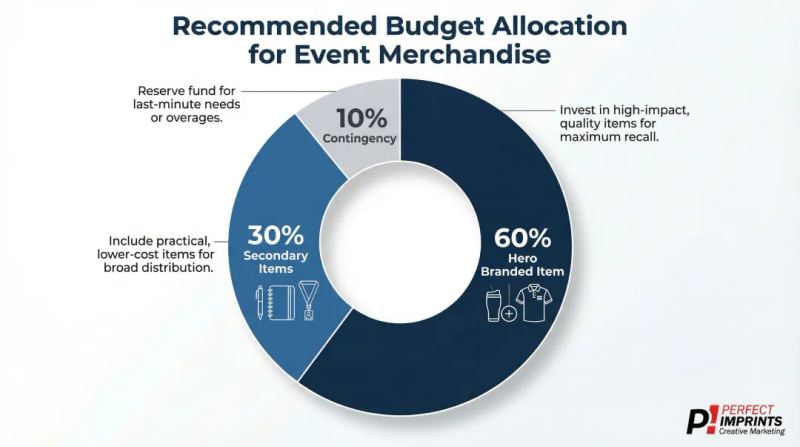
Set this budget early in the planning process and stick to it.
Vendor Consolidation Saves Money and Simplifies Logistics
A common budgeting mistake is splitting orders across too many vendors to save on individual items. This eliminates volume discounts and complicates logistics. Working with fewer, well-chosen suppliers yields better pricing, stronger supplier performance, and far less administrative overhead.
Consolidating with one supplier — such as Perfect Imprints — produces consistent results across your order:
- Fewer approval rounds and fewer shipping variables to track.
- Better per-unit pricing as your total order volume grows.
- Easier reorders when you need to top off quantities before the event.
Frequently Asked Questions
The 5 C's are Concept, Crowd, Coordination, Communication, and Culmination: the five core pillars guiding every event from initial concept through post-event follow-up. Each element directly influences bulk ordering decisions.
Most custom bulk orders require 2–6 weeks for production plus shipping time. Q1 2026 events should ideally have orders placed by late November or December 2025 to avoid rush fees and delays caused by Chinese New Year shutdowns and tariff-related capacity constraints.
Minimums vary by product type—typically 12–24 units for apparel and 50–100 units for items like pens, bags, or drinkware. Higher quantities unlock lower per-unit pricing, so ordering at the next pricing tier often reduces total cost.
Branded tote bags, drinkware, apparel, lanyards, and notebooks top the list for corporate events due to their daily utility and brand visibility. ASI's 2026 study confirms that T-shirts ($4.3B), drinkware ($2.8B), and polos ($2.5B) dominate industry sales.
Use the 10–15% buffer rule: multiply expected attendance by 1.1 to 1.15 to account for walkup guests, spares, and last-minute additions. For example, 300 expected attendees × 1.15 = 345 units; round to 350 to hit the nearest pricing tier.
Rush production is possible for some items but carries additional cost (15–30% surcharges) and may limit customization. Prioritize in-stock items with imprinting options and focus rush budget on the most visible branded pieces like bags or apparel rather than lower-visibility items.
Read Related Blogs
Custom Branded Merchandise Ordering Guide: Complete Guide
Master custom branded merchandise ordering with our complete guide. Plan orders, choose products, pick decoration methods, and avoid costly mistakes. Start today!
9 Affordable Trade Show Giveaways That Drive Lead Capture
Discover 9 affordable trade show giveaways that actually capture leads. Learn which promotional items drive engagement and maximize your event ROI.
Screen Printing on Promotional Products: Complete Guide
Master screen printing on promotional products. Learn how it works, which items qualify, costs, and when to choose it over other decoration methods.