Apr 3, 2026
Custom Branded Merchandise Ordering Guide: Complete Guide
Introduction
Most organizations know they need branded merchandise — then stall out trying to figure out where to start, what to order, or why their last batch didn't land. Custom branded merchandise covers any physical item imprinted with your logo, tagline, or brand colors: apparel, drinkware, bags, tech accessories, stationery, and promotional products.
This guide is for business owners, marketing managers, HR teams, and event organizers in healthcare, construction, education, real estate, non-profits, associations, and beyond. Whether you're outfitting a team, thanking clients, or building brand visibility at an event, the right merchandise drives real recognition — but only if you navigate the ordering process correctly.
This guide covers how to plan your order, choose the right products and decoration methods, navigate the ordering process step by step, and avoid the most common and costly mistakes that derail even experienced buyers.
Key Takeaways
- Branded merchandise outlasts digital ads — recipients keep physical items for months or years, extending your marketing reach.
- Define your goal first: brand awareness, team uniforms, client gifts, or event giveaways each call for different products.
- Cost and print quality depend on product type, decoration method, order quantity, and artwork file quality.
- Every order follows the same steps: define needs → choose products → submit artwork → review proof → approve → produce → receive.
- The most expensive mistakes are leaving insufficient lead time, prioritizing low price over quality, and skipping the proof review.
What Is Custom Branded Merchandise and Why Does It Matter?
Custom branded merchandise includes any physical item customized with a company's logo, tagline, or brand colors. Common categories are apparel, drinkware, bags, stationery, and tech accessories — each serving a different audience and campaign goal.
Businesses across industries invest in branded merchandise because it functions as a long-term, tangible marketing asset that generates repeated brand impressions. The promotional products industry reached $27.7 billion in North America in 2025, outperforming overall U.S. economic growth. That figure isn't just a market stat — it reflects how reliably physical items outperform other channels for recall and engagement.
Unlike a paid ad that disappears once the budget stops, a branded item stays in use for months or years — driving cost-per-impression far below digital alternatives. Research shows that 85% of consumers remember the advertiser who gave them a promotional item, and 25% keep promotional products for longer than five years.
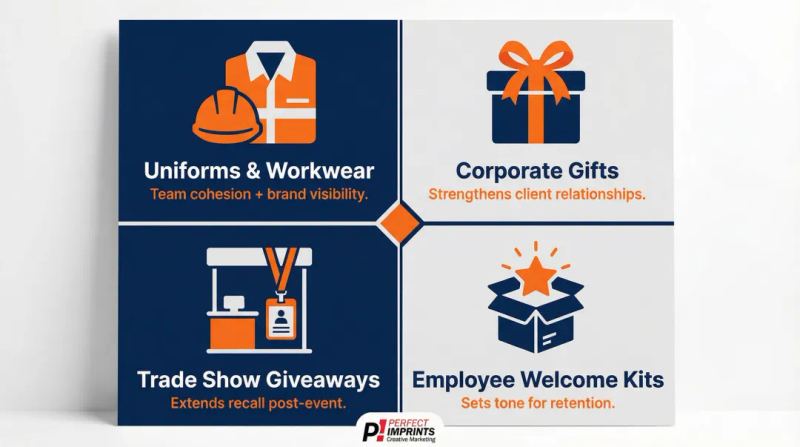
Certain use cases consistently deliver the strongest ROI:
- Uniforms and workwear build team cohesion while turning employees into walking brand ambassadors
- Corporate gifts strengthen client relationships in ways that email follow-ups rarely do
- Trade show giveaways extend brand recall long after the event floor clears
- Employee welcome kits create a memorable first impression that sets the tone for retention
Choosing items recipients will actually use is what separates forgettable giveaways from lasting brand impressions. Functional, quality merchandise generates thousands of impressions over its lifetime at a fraction of what digital or broadcast advertising costs.
How to Plan Your Custom Merchandise Order
Start with a Clear Goal
The purpose of your order shapes every subsequent decision. Walk through the four most common use cases and identify which applies to your project:
Team uniforms/workwear — Prioritize durability, comfort, and professional appearance. Employees will wear these items repeatedly, so quality matters more than variety.
Client/corporate gifts — Focus on perceived value and usefulness. The item should reflect positively on your brand and be something the recipient keeps and uses.
Event giveaways — Maximize visibility and brand impressions. Choose items people will use in public settings where others will see your logo.
Merchandise for resale — Balance quality with margin. The item must be desirable enough that customers will pay for it while still allowing you to profit.
Each use case has different priorities. A construction crew needs durable, moisture-wicking workwear, while a real estate office benefits from polished polos and branded stationery.
Define Your Audience Before Selecting Any Product
The recipient's daily routine, work environment, and preferences should drive product selection. Ask yourself:
- Where does the recipient spend their time?
- What would they actually use daily?
- Does their work environment require specific features (moisture-wicking, stain-resistant, durable)?
Once you know your audience, you can set a budget that actually matches what they'll value — and avoid spending on custom products that end up in a drawer.
Set a Realistic Budget Early
Include all cost components when setting your budget:
- Base product price per unit
- Decoration cost (printing, embroidery, setup fees)
- Setup fees (screen creation, digitizing fees)
- Shipping costs
- Rush charges (if applicable)
Per-unit cost drops as quantity increases — a basic 1-color t-shirt may run $5.00–$6.50 at 100 pieces, but noticeably less at 250 or 500. Knowing the full cost structure before you browse custom merchandise keeps your expectations grounded.
Confirm Your Artwork Situation Before Requesting a Quote
Print-ready artwork is essential before you request a quote. Ideally, that means a vector file (.AI, .EPS, or .PDF); at minimum, a high-resolution raster file (300 DPI .PNG or .JPG). If you don't have either, factor design work into both your budget and timeline.
Suppliers like Perfect Imprints offer in-house graphic design services to develop or clean up artwork when needed. If you don't have a print-ready logo, ask your supplier about design support before requesting a quote for your custom branded merchandise.
Build in Appropriate Lead Time
Standard production typically takes 10–15 business days after proof approval. First-time orders often take longer due to artwork revisions, proof feedback delays, and back-and-forth communication.
Recommended timeline:
- Plan at least 3–4 weeks ahead of any deadline.
- Allow longer for large or complex orders.
- Factor in shipping time after production completes.
- Build in buffer time for unexpected delays.
Rush production is available, but it costs more and narrows your product and decoration options. The earlier you start, the more flexibility you have on both.
Choosing the Right Products and Decoration Methods
Most-Ordered Product Categories for Business Use
The product categories most frequently ordered for business use include:
- Apparel — t-shirts, polos, button-downs, hoodies, jackets
- Drinkware — water bottles, mugs, tumblers, insulated bottles
- Bags — totes, backpacks, drawstring bags
- Stationery — notebooks, pens, padfolios
- Tech accessories — USB drives, chargers, phone accessories
Wearables and apparel accounted for 26.6% of all industry sales in 2024, followed by drinkware at 10.2% and caps/hats at 9.0%.
Pick items recipients will use regularly — not novelty items that collect dust. The daily use test is the most reliable filter for product selection.
Apparel: Matching the Garment to the Environment
Work environment determines the best apparel choice:
- Outdoor trades — moisture-wicking performance shirts, durable workwear
- Client-facing professionals — polos, button-downs, professional outerwear
- Casual or event settings — t-shirts, hoodies, casual jackets
- Corporate or financial services — button-downs, blazers, dress shirts
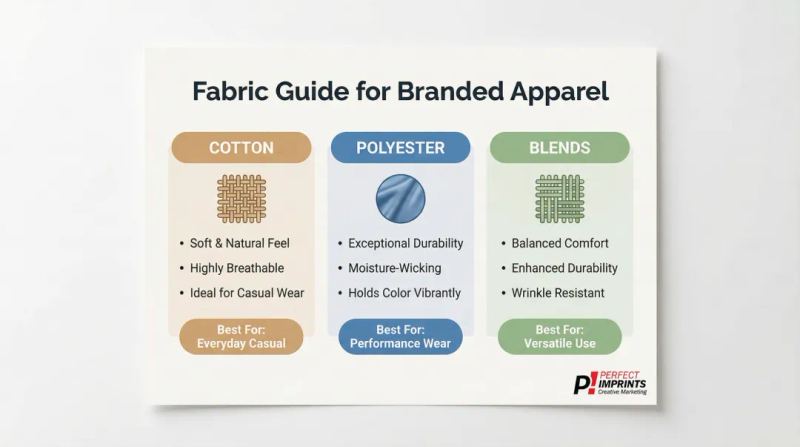
Fabric considerations:
- Cotton — soft, breathable, comfortable; best for casual wear
- Polyester — durable, moisture-wicking, wrinkle-resistant; best for performance wear
- Blends — combines benefits of both; balances comfort and durability
Durability and comfort matter for items employees wear regularly. A cheap t-shirt that shrinks or fades after three washes creates a negative brand impression.
Decoration Methods: Screen Printing vs. Embroidery vs. Other Options
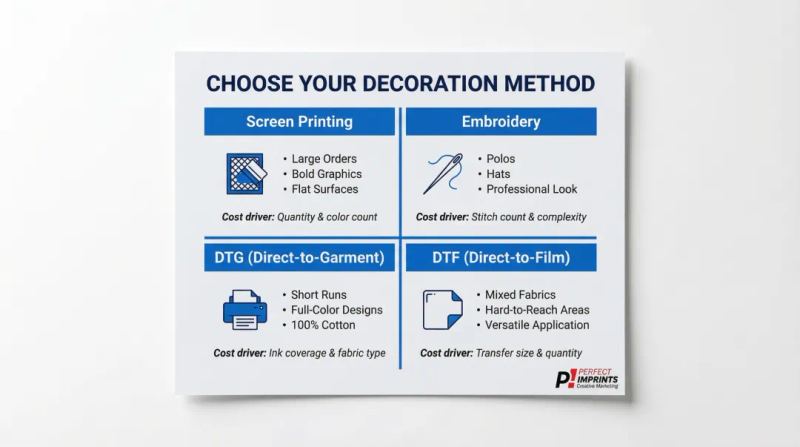
Screen Printing:
Screen printing applies ink directly through a mesh screen onto the fabric. It's best for large quantities, bold graphics, and flat surfaces. Cost-effective per unit at scale, but setup costs (creating screens) make it less economical for very small runs. Ideal for t-shirts, hoodies, and bags.
Cost drivers: Number of ink colors and setup fees for each screen.
Embroidery:
Embroidery uses stitched thread to create a textured, premium look. Best for polos, button-downs, hats, and any item where a professional or executive appearance is the goal. Cost is based on stitch count rather than color count, and it holds up extremely well through repeated washing.
Cost drivers: Stitch count and digitizing fees to convert artwork into embroidery format.
Direct-to-Garment (DTG):
DTG prints water-based pigment inks directly onto fabric after applying a bonding pre-treatment. It works best on 100% cotton, short runs, and photo-quality, full-color prints. There are no screen setup fees, but it's slower for bulk orders.
Direct-to-Film (DTF):
DTF prints digital designs onto a PET film, coats them with hot-melt adhesive powder, and heat-transfers them to fabric. It works on virtually any fabric — cotton, poly, blends, and nylon — and is ideal for hard-to-reach areas and full-color designs without weeding.
Choosing the right method:
- Large orders (24+ units), 1-2 colors → Screen printing
- Professional appearance, polos, hats → Embroidery
- Low-volume, full-color, complex designs → DTG or DTF
- Mixed fabrics, hard-to-reach areas → DTF
How the Custom Merchandise Ordering Process Works
Ordering custom branded merchandise follows a consistent path regardless of supplier. Knowing what to expect at each stage keeps you in control, avoids delays, and protects quality.
Step 1: Submit Your Brief and Request a Quote
Include the following in your quote request:
- Product type (t-shirts, polos, water bottles, etc.)
- Quantity
- Decoration method (screen printing, embroidery, DTG, DTF)
- Number of colors in the design
- Desired placement locations (left chest, full back, etc.)
- Garment brand preferences (if any)
- Garment colors
- Delivery deadline
The more specific the brief, the more accurate the quote. A good supplier will walk you through options and flag anything that could affect cost or quality before the order is confirmed.
Step 2: Review Pricing and Confirm Your Order
Evaluate a quote by looking beyond the per-unit price:
- Setup fees (screen creation, digitizing, tape charges)
- Shipping costs
- Revision charges (if applicable)
- Turnaround time
- Bulk pricing tiers
Confirm that bulk pricing tiers are clearly shown. Once pricing is accepted, the order is typically confirmed with payment (full or deposit depending on the supplier).
Step 3: Artwork Submission and Design Approval
The supplier creates a digital mockup showing how the design will appear on the product, including placement, scale, and color. This is the most critical review point.
Check carefully:
- Spelling and grammar
- Logo accuracy (correct version, no outdated elements)
- Color matching (does it match your brand colors?)
- Sizing (is the logo too large or too small?)
- Placement (is it centered and positioned correctly?)
Production does not begin until you give written approval. This is the last chance to catch errors — changes requested after approval can trigger additional costs and push your delivery date.
Step 4: Production
We source garments, set up screens or embroidery files, and decorate items in batches with quality checks throughout. Typical turnaround after proof approval: 10–15 business days, depending on order size and decoration complexity.
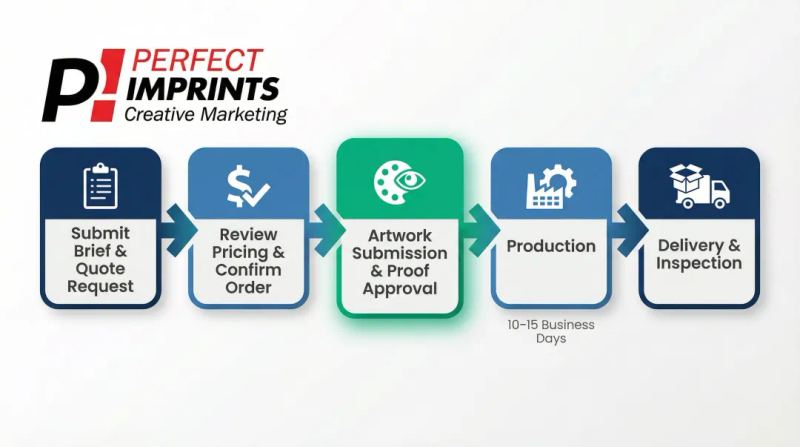
Step 5: Delivery and Receiving Your Order
Orders ship with tracking, and buyers should inspect items upon receipt against the approved proof. Document any discrepancies immediately.
For businesses ordering for teams or events:
- Confirm delivery address before production begins
- Build in buffer time before the event date
- Order extra units to cover size variations or last-minute additions
- Inspect the order immediately upon delivery
Common Mistakes First-Time Buyers Make
Prioritizing Price Over Quality
The quality of a branded item directly reflects on the brand it represents. Research shows that 72% of consumers believe the quality of a promotional product reflects the reputation of the company giving it.
Cheap materials, poor print quality, or items that fall apart quickly create a negative impression that no cost savings can offset.
Budget for quality, not just quantity. A $10 premium water bottle that gets used daily for two years generates far more brand impressions than a $2 plastic cup that breaks after one use.
Underestimating Lead Time
First-time buyers frequently assume custom orders can be turned around in a few days. Standard production takes 10–15 business days after artwork approval — not after the initial inquiry.
Common delays:
- Artwork revisions and design feedback
- Proof review and approval process
- Back-and-forth communication with the supplier
- Shipping time after production completes
Rush production adds cost and limits your options, so build in realistic buffers and communicate deadlines to the supplier upfront.
Skipping the Proof Review or Approving Too Quickly
The proof stage is the last opportunity to catch errors before items are produced. Many issues — wrong font, incorrect logo version, slightly off color, misaligned placement — are only visible on the mockup.
The buyer bears responsibility for approving a proof. Errors caught at this stage cost nothing; errors caught after production are expensive and may not be correctable.
Review every proof carefully before signing off. A thorough check should include:
- Printing the proof out rather than reviewing on-screen only
- Zooming in on logo details, font size, and placement
- Having at least one other person review before approval
Frequently Asked Questions
Custom branded merchandise costs vary by product type, decoration method, and quantity. Per-unit pricing drops significantly with larger orders. For example, basic 1-color custom t-shirts may cost $5.00–$6.50 per unit at 100 pieces, while embroidered promotional polos range from $24.95–$40.95 per unit at 24 pieces. Factor in setup fees and shipping alongside per-unit price when budgeting.
Standard production typically takes 10–15 business days after proof approval, with rush options available for an additional fee. Plan at least 3–4 weeks ahead of any deadline to allow time for artwork revisions, proof review, production, and shipping.
Vector files (.AI, .EPS, .PDF) produce the sharpest results at any size, while high-resolution raster files (300 DPI .PNG or .JPG) are also acceptable. Lower-resolution files may require cleanup or recreation, which can add time and cost.
Screen printing applies ink directly to the item and works best for bold, colorful designs on flat surfaces at high volumes. Embroidery uses stitched thread for a premium, textured look on polos, hats, and button-downs — at a higher per-unit cost.
Minimums vary by supplier and decoration method. Screen printing typically has higher minimums (12–24 pieces) due to setup costs, while DTG and heat transfer work for smaller runs. Some suppliers offer no-minimum options for samples or small orders, though per-unit costs are higher.
Yes. Most suppliers provide a digital proof before production, and many offer physical samples for a fee. Always review a proof or sample before approving bulk production — especially for first-time orders.
Read Related Blogs
Best Custom Branded Tote Bags for Trade Shows: Complete Guide
Discover the best custom branded tote bags for trade shows. Compare top styles, materials, and design tips to maximize brand visibility on the show floor.
Custom Branding for Small Businesses: Complete Guide
Master custom branding for your small business. Build a strong visual identity, create branded materials, and maintain consistency on any budget. Start today!
Screen Printing on Promotional Products: Complete Guide
Master screen printing on promotional products. Learn how it works, which items qualify, costs, and when to choose it over other decoration methods.