Apr 3, 2026
Shop for Good: Finding the Right Nonprofit Merchandise Partner
Introduction
Nonprofits operate in a constant balancing act: tight budgets, limited staff bandwidth, and the pressure to make every fundraising dollar count. Yet branded merchandise remains a proven tool for building donor loyalty, spreading awareness, and opening new revenue streams. Research shows that 83% of consumers feel appreciated when receiving promotional products, and 90% report improved brand perception afterward.
The real challenge isn't deciding whether to sell merch—it's finding the right partner to produce and fulfill it. A poor vendor choice can mean late shipments that tank a fundraising event, quality issues that undermine your brand, or surprise fees that wipe out your margin. This guide walks through what to look for in a nonprofit merchandise partner—and the red flags to avoid.
Key Takeaways
- Nonprofit branded merchandise supports fundraising, brand awareness, donor engagement, and supporter retention.
- The right partner offers product flexibility, transparent pricing, design support, and reliable fulfillment — price per unit is rarely the only factor that matters.
- Evaluate whether bulk ordering, print-on-demand, or a full-service supplier best fits your needs.
- Red flags like high minimums, poor design support, and unclear turnaround times can derail campaigns.
- Suppliers like Perfect Imprints combine custom product variety with hands-on design support — useful when your team lacks in-house creative resources.
What Is Nonprofit Branded Merchandise—and Why It Works
Nonprofit branded merchandise includes apparel, accessories, stationery, and promotional items that carry an organization's logo, mission messaging, or campaign branding. These items are distributed or sold to supporters, volunteers, staff, or the general public.
Merchandise raises funds directly through sales while serving as passive marketing every time a supporter wears or uses the item in public. According to ASI's research, 63% of recipients keep promotional products for more than a year, creating sustained brand exposure long after the initial transaction.
The reach is measurable. Nearly 80% of U.S. consumers have a more favorable impression of an advertiser after receiving a promotional item, and three in four say they're more likely to do business with a company that gives them promo. For nonprofits, that means more donor touchpoints without additional ad spend.
Types of Merchandise Partners
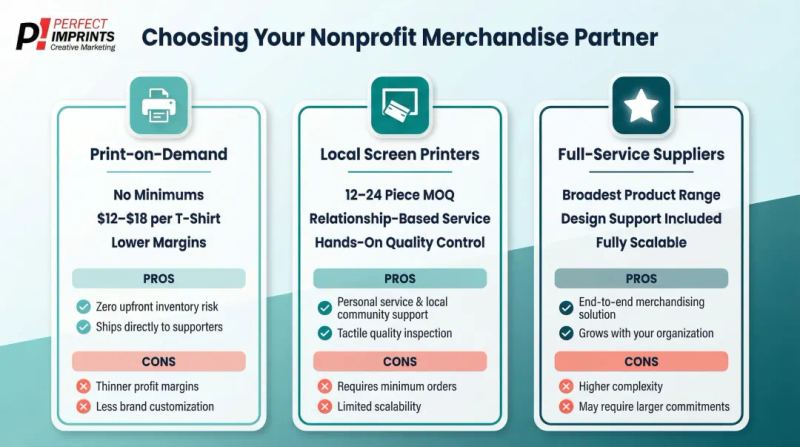
Nonprofits typically choose from three main partner categories:
- Print-on-demand platforms eliminate inventory and upfront costs with no minimums—but unit costs run higher ($12–$18 per t-shirt versus $6–$9 in bulk), which cuts into fundraising margins.
- Local screen printers or embroiderers suit events well and offer relationship-based service. Most require minimum orders of 12–24 pieces per design, with more hands-on quality control.
- Full-service promotional products suppliers like Perfect Imprints offer the broadest product range, design support, and scalability for organizations of any size—handling everything from artwork to production.
A one-time event shirt has different requirements than a long-running online store or year-round volunteer gear program—so the right partner depends on which problem you're actually solving.
What to Look for in a Nonprofit Merchandise Partner
Price alone is the wrong filter. A vendor that delivers late, produces poor-quality items, or can't accommodate a small order quantity can cost more in damage to donor trust than was saved on unit cost.
Product Range and Customization Options
A wide product catalog matters because nonprofits need flexibility to match merchandise to their mission. An environmental organization benefits from custom water bottles, while a literacy nonprofit might prioritize branded tote bags. Growing your offerings over time without switching vendors saves time and maintains consistency.
Customization depth affects whether supporters will actually use your products. Printing methods include:
- Screen printing - Durable, cost-effective for bulk orders
- Embroidery - Professional appearance for apparel
- Full-color digital printing - Ideal for complex logos and detailed designs
The final look and durability directly impact whether a supporter wears that shirt or uses that tote bag repeatedly—making every item a visible reminder of your mission in the real world.
Minimum Order Quantities and Scalability
High minimum order quantities (MOQs) create barriers for small nonprofits. Traditional screen printing typically requires MOQs of 12 to 24 pieces per design due to setup costs for screens, ink mixing, and press alignment. A vendor requiring 144-unit minimums isn't viable for a 50-person charity walk.
Look for partners who can accommodate small runs without steep per-unit price penalties. Direct-to-garment (DTG) printing, for example, can handle orders as small as one piece.
Scalability cuts both ways. As your organization grows and plans larger events or campaigns, your partner should handle increased volume without friction — so you're not re-vetting vendors every time your needs shift.
Pricing Transparency and Nonprofit Pricing
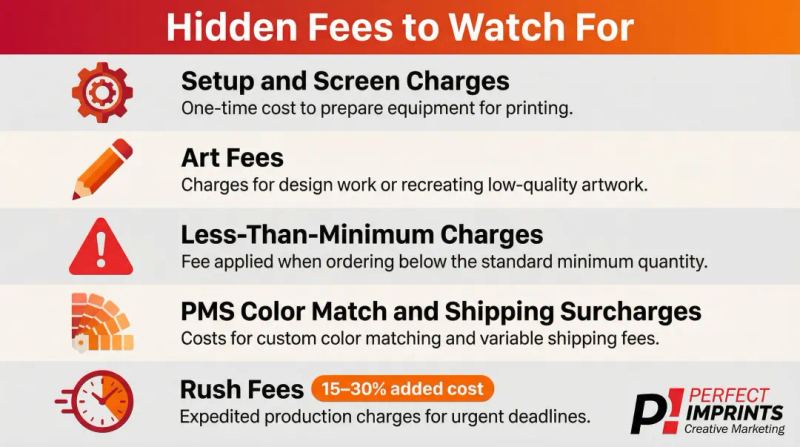
Hidden costs can dramatically eat into margins on a merchandise fundraiser. Common fees include:
- Setup and screen charges — Press preparation plus a per-color fee for each ink in your design
- Art fees — Charged when artwork needs vectorizing or color-matching before it's print-ready
- Less-than-minimum charges — Per-unit penalties when ordering below a vendor's MOQ
- PMS color match and shipping surcharges — Exact Pantone matching and remote/expedited delivery add-ons
- Rush fees — Fast-track production typically adds 15–30% to your total cost
Always request a fully itemized quote before committing. Some vendors offer nonprofit discounts or waive setup fees for registered 501(c)(3) organizations, though there is no industry-wide standard. Ask explicitly—it's not always advertised.
Design Support and Artwork Capabilities
Many nonprofits lack dedicated graphic designers, making in-house design support one of the most practical differentiators to look for in a vendor. A partner who can review or prepare your artwork means fewer production delays and a more professional finished product.
A vendor with solid design capabilities can typically help with:
- Vectorizing low-resolution logos for clean, scalable output
- Color-matching to your brand's exact Pantone or hex values
- Flagging file issues before production — not after
That last point matters most. Catching a print-incompatible file early prevents reprints, wasted orders, and the kind of last-minute scramble that derails event timelines.
Turnaround Time and Fulfillment Reliability
Nonprofit merchandise deadlines are non-negotiable — fundraising galas, charity runs, and awareness campaigns don't reschedule around production delays. Production lead times and on-time delivery track records are critical decision factors.
Industry benchmarks for production include:
- Screen printing: 7-10 business days after artwork approval
- Embroidery: 7-14 business days for standard orders
- Print-on-demand: 2-5 business days for fulfillment
Rush orders are available but come at a premium. Rush delivery can cost an additional 15% for one-week delivery or 30% for three-day delivery.
Consider fulfillment for ongoing online stores: Does the vendor handle shipping and returns, or will staff need to manage inventory and fulfillment manually? Most vendor comparisons skip this labor cost entirely — until it shows up as unplanned staff hours.
Red Flags to Watch for When Evaluating Vendors
Not every promotional products vendor knows how to work with nonprofits. Watch for these warning signs before committing to an order:
- Slow inquiry responses — If a vendor takes three days to return a quote, expect the same delays when a production issue surfaces mid-order. Test their responsiveness before placing anything.
- No proof or sample process — Vendors who skip artwork proofs or physical samples put your limited budget at risk. A proof review catches incorrect colors, misspelled text, and poor print quality before it's too late to fix.
- No nonprofit references — A vendor without clients from mission-driven organizations may not understand budget sensitivity, mission alignment, or hard event deadlines. Ask specifically for nonprofit references during vetting.
How Perfect Imprints Can Help
Perfect Imprints is a full-service promotional products and custom printing partner for nonprofits, backed by a 5-star Google Business Profile rating across 100+ reviews. That reputation reflects consistent quality and service—exactly what organizations with tight budgets and reputations to protect need.
Key capabilities relevant to nonprofits include:
- Wide product catalog spanning apparel, drinkware, bags, tech accessories, and branded promotional items
- In-house graphic design and artwork support to help organizations without dedicated designers
- Flexible order sizes to serve small nonprofits and large campaigns alike
- Multiple customization methods including screen printing, embroidery, and full-color digital printing
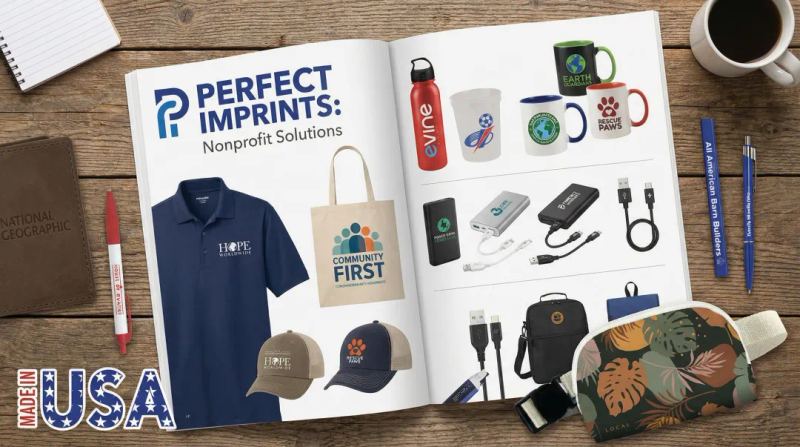
Those capabilities translate into a practical workflow advantage: as both a screen printer and promotional products supplier, Perfect Imprints handles design through production under one roof. That means fewer vendors to manage and no hand-off gaps between a design team and a separate print shop.
To get started or request a quote, contact Perfect Imprints at +1 850-200-4020, Monday through Friday, 8AM–5PM.
Conclusion
The right merchandise partner does more than fulfill orders — they become an extension of your nonprofit's brand and support your mission order after order.
Evaluate vendors the same way you evaluate any operational partner: by looking at reliability, communication, value (not just price), and alignment with your organization's values. Revisit the vendor relationship annually, or whenever your organization scales significantly — what works for a small charity walk may not serve a statewide awareness campaign two years later.
Frequently Asked Questions
Nonprofits can legally sell merchandise as long as it aligns with the mission and revenue is used for organizational purposes. However, proceeds may be considered unrelated business income (UBIT) if the merchandise isn't tied to the mission. Consult a tax advisor for complex situations, especially if merchandise sales exceed $1,000 annually.
Custom t-shirts, branded tote bags, promotional water bottles, and logo-printed hoodies are consistently the strongest performers. Prioritize items supporters will use repeatedly—and choose products that reflect your mission, such as reusable bottles for environmental causes or tote bags for literacy organizations.
Print-on-demand eliminates inventory risk but typically offers lower margins per item (20-30% versus 50-70% for bulk). Bulk ordering lowers per-unit costs but requires upfront investment and storage. The right choice depends on your nonprofit's cash flow, storage capacity, and expected demand—test designs with POD, then move proven sellers to bulk.
Budget $8–15 per unit for basic t-shirts in small quantities, or $3–6 per unit in bulk orders of 100+. Costs vary by product type and customization, so request itemized quotes from multiple vendors and build in a buffer for setup fees, shipping, and potential reprints.
Merchandise given to existing donors as thank-you gifts or event giveaways reinforces their connection to the cause and is linked to higher repeat giving rates. The key is positioning it as genuine appreciation—not a transactional incentive.