Apr 3, 2026
How Promotional Products Support Employee Wellness Programs
Introduction
Employers are investing more in workforce well-being as healthcare costs rise, talent retention becomes harder, and post-pandemic expectations shift. In 2025, annual premiums for employer-sponsored family health coverage hit $26,993—a 6% increase from 2024—pushing 83% of large firms to offer wellness programs like smoking cessation, weight management, and behavioral coaching.
Yet most organizations pour resources into program content—gym memberships, health screenings, digital apps—while overlooking how physical, branded touchpoints help those programs stick. Without tangible items connecting employees to a wellness initiative, participation drops sharply after launch, and the program fades into the background.
This article explains how promotional products serve a measurable, practical role inside employee wellness programs—boosting participation, building program identity, and sustaining behavior change long after launch day.
Key Takeaways
- Promotional products serve as participation triggers, daily behavior reminders, and culture signals—not just branded merchandise.
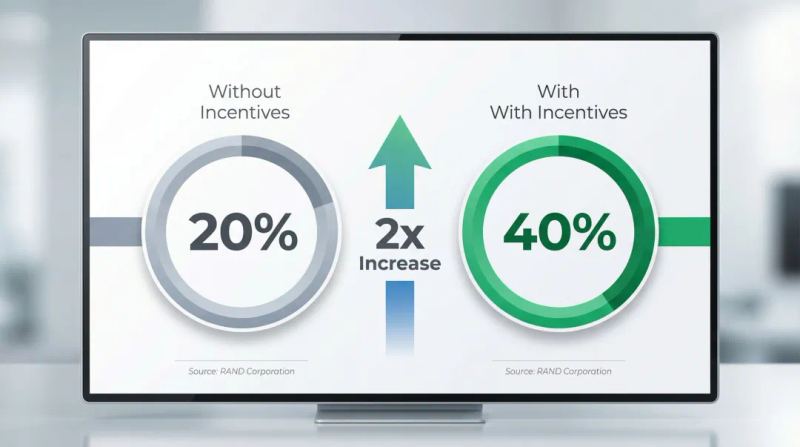
- Wellness programs that use rewards double participation rates from 20% to 40%, making them cost-effective tools for sustaining engagement.
- The right products address both physical health and mental well-being—and the distinction matters when choosing what to give.
- Branded merchandise works best as an ongoing investment—tied to program goals and distributed at the moments that drive action.
What Role Do Promotional Products Play in Employee Wellness Programs?
In this context, promotional products are branded, functional items—custom water bottles, fitness gear, stress relievers, wellness kits—given to employees as part of a structured wellness initiative, not generic giveaways.
They fit into the wellness program ecosystem as:
- Launch incentives that generate initial buy-in
- Milestone rewards that recognize progress
- Challenge prizes that sustain mid-program engagement
- Awareness tools that keep initiatives visible
- Everyday habit reinforcers that embed healthy behaviors into daily routines
Promotional products work best as a means to an outcome—driving participation, reinforcing behavior change, and embedding wellness into company culture. Their effectiveness depends on being tied to specific program goals, not distributed randomly.
Key Advantages of Promotional Products in Employee Wellness Programs
The advantages below focus on measurable, operational impact tied to outcomes organizations track: participation rates, retention, absenteeism, healthcare costs, and employee engagement scores.
Advantage 1: Driving Employee Participation and Sustaining Engagement
One of the most persistent challenges in corporate wellness programs is participation drop-off. Initial excitement fades, and employees disengage within weeks or months of program launch.
Promotional products function as participation triggers:
- Branded incentives at launch events create immediate buy-in
- Challenge prizes for milestone completion sustain mid-program momentum
- Surprise distributions throughout the year keep wellness programs visible and create recurring engagement moments
The behavior loop:
Physical rewards create a direct behavior loop—employees are more likely to act when there's a physical reward tied to the action. Employers that use rewards report a median participation rate of 40%, double the 20% rate for programs without incentives.
Higher participation rates lead to faster return on wellness program investment. While the widely cited 2010 figure of $3.27 saved per $1 spent has been disputed by recent research, RAND's 2014 analysis found an overall ROI of $1.50 per dollar invested, with lifestyle management programs becoming cost-neutral after approximately five years of continuous participation.
KPIs impacted: Wellness program participation rate, challenge completion rate, employee engagement scores, absenteeism rate
When this matters most: Program launches, seasonal wellness challenges, annual re-enrollment periods, and when engagement metrics are trending downward
Advantage 2: Reinforcing Wellness Culture and Employer Brand
Branded wellness products serve a dual function—they are both a functional item (a water bottle the employee uses daily) and a symbol of the company's commitment to employee well-being.
When employees regularly use a branded insulated water bottle, a company-logo stress reliever, or a fitness band, the brand is associated with their healthy behaviors—reinforcing that the employer values their health beyond just productivity.
Why retention follows recognition:
Employee perception of employer care directly correlates with retention. Gallup's 2024 data shows that employees who receive high-quality recognition are 45% less likely to have turned over after two years. Branded wellness merchandise makes that recognition concrete and visible.
Wellness programs also influence candidates before they're hired. According to the 2025 SHRM Employee Benefits Survey, 88% of employers rate health-related benefits as "very important" or "extremely important" to their workforces, and 31% of voluntary turnover is attributed to well-being and work-life balance issues.
KPIs impacted: Employee satisfaction scores, employer brand perception, voluntary turnover rate, talent acquisition conversion rates
When this matters most: Highest impact during onboarding (when new employees form first impressions), during open enrollment cycles, and in competitive hiring markets where employer brand differentiation matters
Advantage 3: Supporting Sustained Behavior Change Across Physical and Mental Wellness
Employees may want to be more active or manage stress better, but intent rarely translates on its own. Products in their hands—resistance bands at home, a wellness journal at their desk—reduce friction and create environmental triggers for healthy habits.
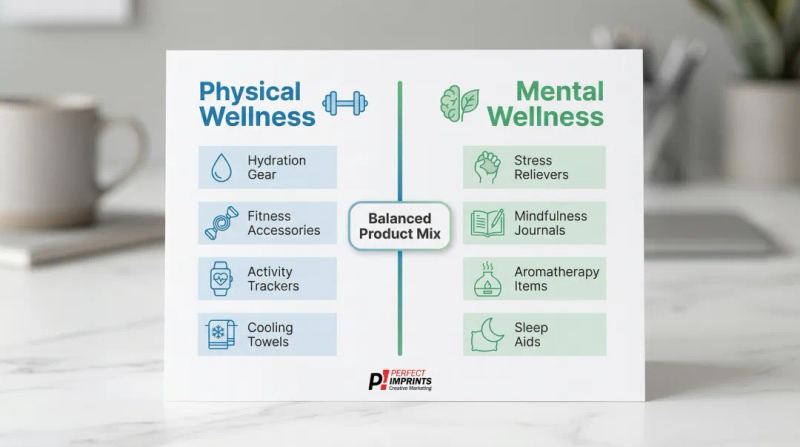
A balanced product mix covers both dimensions:
- Physical wellness products: Hydration gear, fitness accessories, activity trackers
- Mental wellness products: Stress relievers, sleep aids, mindfulness journals, aromatherapy items
Why environmental cues matter:
Behavioral science emphasizes the role of environmental cues in habit formation. Having wellness tools physically present in an employee's workspace or home increases the likelihood they'll use them. Research shows that habits emerge from learning associations between responses and features of performance contexts—physical settings, objects, and predictable cues.
KPIs impacted: Stress-related absenteeism, self-reported well-being scores, healthcare utilization, productivity metrics
When this matters most: High-stress periods (year-end deadlines, restructuring, return-to-office transitions) and for remote/hybrid employees who may feel less connected to workplace wellness initiatives
What Happens When Wellness Programs Skip Promotional Products
The most common outcome: programs launch with good intentions but lose momentum within the first few months. Without visible, tangible touchpoints, wellness initiatives become invisible and employees assume they're optional or low-priority.
The cascading consequences:
- Low participation leads to poor program ROI
- Poor ROI leads to budget cuts
- Budget cuts further erode any wellness culture the program was meant to build
The broader business risk is severe. Gallup estimates that employees who are not engaged or actively disengaged cost the world $8.8 trillion in lost productivity, equal to 9% of global GDP.
That disengagement doesn't stay abstract — it accelerates burnout, which drives turnover. When employees leave, replacement costs add up fast. The Work Institute calculates the total cost of turnover at 33.3% of an employee's base salary, factoring in recruiting, onboarding, and lost productivity.
How to Build a Smarter Wellness Promotional Product Strategy
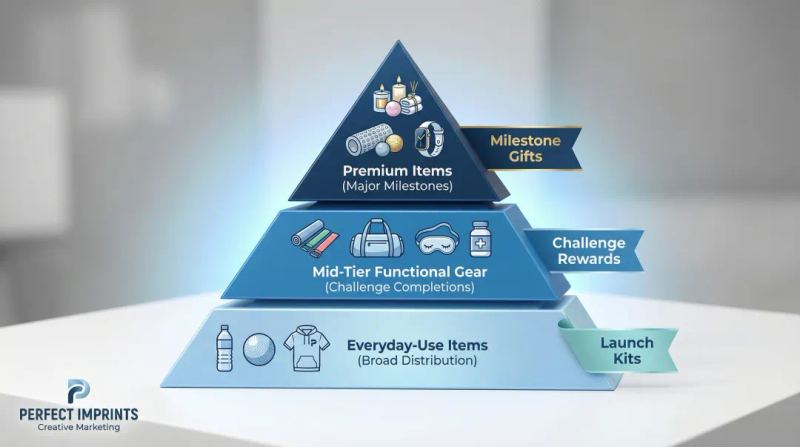
Timing and product selection both matter. Distribute items at three key program phases:
- Launch kits to generate initial buy-in
- Challenge rewards to sustain engagement mid-program
- Milestone gifts to recognize long-term participation
Tiered Product Approach
Everyday-use items (for broad distribution):
- Branded water bottles and insulated tumblers
- Stress balls and fidget tools
- Branded apparel and cooling towels
Mid-tier functional wellness gear (for challenge completions):
- Resistance bands and exercise sliders
- Fitness bags and pedometers
- Sleep aids and aromatherapy candles
- Branded yoga mats or stretching guides
Premium items (for major milestones or annual recognition):
- High-end spa kits
- Recovery tools (massage devices, foam rollers)
- Premium fitness trackers
Perfect Imprints supplies branded wellness merchandise across all three tiers — each item imprinted with your organization's logo and ready to ship in bulk quantities.
Consistency Over Cost
Products employees actually use in their daily wellness routines generate far more engagement and brand impressions than expensive items with no practical connection to healthy habits. A $15 insulated water bottle used daily for a year delivers more value than a $50 item that sits in a drawer.
Conclusion
Promotional products earn their place in wellness programs as practical tools that drive participation, signal employer care, and reinforce healthy habits employees actually use. The effect builds when the strategy stays consistent.
A wellness swag strategy timed to key milestones, matched to program goals, and refreshed each cycle is one of the most cost-effective moves HR and marketing teams can make. Tangible reinforcement raises participation rates, strengthens workplace culture, and turns programs employees ignore into ones they actually engage with year after year.
Frequently Asked Questions
The most effective categories include hydration gear (custom water bottles, tumblers), fitness accessories (resistance bands, pedometers, cooling towels), stress relief items (stress balls, fidget tools), and mental wellness tools (journals, aromatherapy candles, sleep aids). The best choices align with specific program goals rather than being generic giveaways.
Tangible rewards create a behavior loop: employees are more likely to participate when a physical reward is tied to specific actions, and product touchpoints keep the program visible beyond the launch event. Research shows incentive-based programs double participation rates from 20% to 40%.
Yes. Employees who receive high-quality recognition are 45% less likely to turn over after two years. Wellness program investment — including promotional products — improves satisfaction and loyalty, and companies with visible wellness commitment consistently see lower intent to leave.
Remote employees are often under-served by traditional wellness programs. Mailed wellness kits or care packages with branded products are one of the most effective ways to make remote workers feel included and supported, bridging the gap created by physical distance from the office.
Well-run wellness programs generate a positive return over 2-5 years, and promotional products amplify that ROI by increasing participation. Programs that start at $0.50 per dollar typically become cost-neutral around year five, with higher participation driving healthcare savings, reduced absenteeism, and improved retention.
Refresh products at key program moments (annual re-enrollment, new seasonal challenges, major milestones) to maintain novelty and engagement. Distributing the same items year after year reduces their impact, while strategic refreshes signal ongoing investment and keep the program feeling dynamic rather than stale.
Read Related Blogs
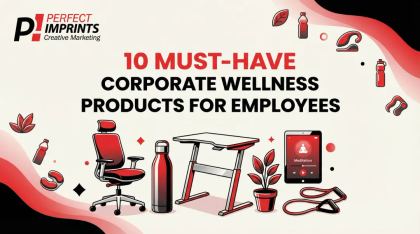
10 Must-Have Corporate Wellness Products for Employees
Discover 10 must-have corporate wellness products that boost employee health and productivity. Find the best options to invest in your team's well-being today!
9 Affordable Trade Show Giveaways That Drive Lead Capture
Discover 9 affordable trade show giveaways that actually capture leads. Learn which promotional items drive engagement and maximize your event ROI.
Screen Printing on Promotional Products: Complete Guide
Master screen printing on promotional products. Learn how it works, which items qualify, costs, and when to choose it over other decoration methods.