Apr 3, 2026
Custom Printed Tote Bags Reviewed: 7 Best-Selling Styles Compared
Introduction
Imagine a marketing manager preparing for a major trade show, staring at dozens of tote bag options online, unsure which style will print cleanly, hold up under daily use, or feel premium enough for a VIP gift bag. The wrong choice can mean wasted budget, poor brand perception, and bags that end up in the trash instead of circulation.
Custom printed tote bags deliver strong brand visibility across industries — from nonprofits and healthcare to education and corporate events. According to PPAI's promotional products research, a single promotional bag generates nearly 5,000 lifetime impressions, with 43% of recipients keeping them for over two years. Not all styles are equal, though — print quality, durability, and use-case fit vary widely by bag type.
What follows is a practical, side-by-side comparison of 7 best-selling custom tote bag styles — each evaluated on material, printability, durability, and ideal use cases — so you can match the right bag to your campaign before placing a bulk order.
Key Takeaways
- Tote bag style, fabric weight, and print surface all affect print quality and how your brand comes across.
- Canvas (10–12 oz.) totes are the most versatile and printable; organic cotton adds sustainability appeal; non-woven bags win on bulk pricing.
- Zipper and gusseted styles offer premium functionality for corporate gifts and retail merch.
- Match bag style to printing method: screen printing, DTG, and embroidery each perform differently across fabric types.
What Makes a Great Custom Printed Tote Bag?
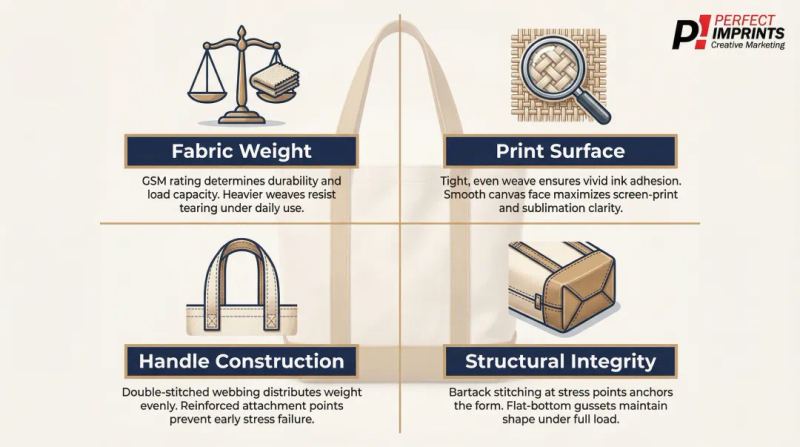
Four key factors separate a good custom tote from a bad one:
1. Fabric Weight Canvas weight dictates thickness, tear resistance, and structural rigidity, measured in ounces per square yard (oz/yd²) or grams per square meter (GSM). Heavier canvas holds screen print ink without bleed-through, while lighter cotton may suit single-color prints or DTG better.
2. Print Surface Smooth versus textured canvas directly impacts print clarity. A tight, flat weave prevents ink skipping and offers maximum ink absorption—critical for multi-color screen prints.
3. Handle Construction Flat webbing handles provide lightweight, washable everyday use. Rope handles offer a nautical look but aren't ideal for very heavy loads. Leather or faux-leather handles add sophistication for executive gifts.
4. Structural Integrity Reinforced seams, gussets, and rigid construction determine whether a bag holds shape when loaded—affecting both function and brand impression.
Use Case Drives Style Selection A bag for a one-time festival giveaway has very different requirements than a reusable branded bag for a nonprofit or a premium corporate gift. Getting this match right—style, fabric, and print method aligned to the occasion—is what separates a bag that gets used from one that gets discarded. The seven styles below are evaluated with exactly that in mind.
7 Best-Selling Custom Printed Tote Bag Styles Compared
These 7 styles represent the most commonly ordered custom tote bag categories across events, retail, corporate gifting, and promotional campaigns, evaluated based on material quality, printability, durability, and cost-to-value.
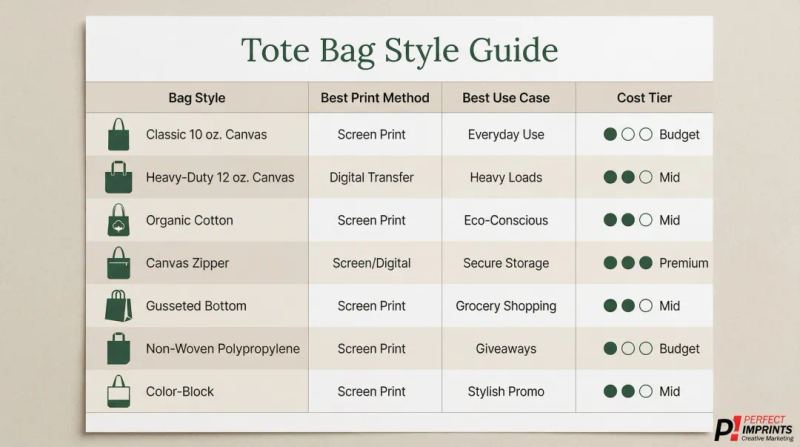
Classic 10 oz. Cotton Canvas Tote Bag
The industry workhorse: a lightweight, flat-weave cotton canvas bag universally compatible with screen printing and widely used for trade shows, schools, and nonprofit giveaways.
Why It Stands Out: Affordable price point makes it ideal for bulk orders. The flat surface takes single- and multi-color screen prints cleanly without bleed, and natural cotton feel adds a tactile brand impression.
| Attribute | Specification |
|---|---|
| Material / Weight | 100% cotton canvas, approx. 10 oz. (~339 GSM) |
| Best Print Method | Screen printing (1-4 colors); basic DTG |
| Best For | High-volume giveaways, trade shows, school events |
Heavy-Duty 12 oz. Canvas Tote Bag
The step-up option: thicker weave, stronger seams, and a more structured silhouette that holds shape when loaded—popular with retailers and corporate clients who want a bag that looks premium and lasts.
Why It Stands Out: The extra fabric weight prevents ink bleed-through on the back panel, making it ideal for full-front screen prints or embroidery. Reinforced stitching at the handles adds longevity for daily-use branded merch. The added structure lets the bag stand upright on its own, a practical edge for artist merch and heavier corporate kits.
| Attribute | Specification |
|---|---|
| Material / Weight | 100% cotton canvas, approx. 12 oz. (~407 GSM) |
| Best Print Method | Screen printing, embroidery (requires Sharp Point 90/14 needles) |
| Best For | Branded merch, retail resale, corporate swag |
Organic Cotton Tote Bag
The sustainability-forward option: made from certified organic cotton with no synthetic blends, appealing to nonprofits, health-conscious brands, and eco-focused campaigns.
Why It Stands Out: Organic cotton has a slightly softer hand feel than standard canvas and prints cleanly with water-based inks. The "organic" credential is a visible brand value-add — and the numbers back it up: 74% of consumers say they feel more favorable about brands that give eco-friendly promo products. For healthcare, education, and environmental organizations, GOTS certification (requiring ≥95% organic fibers) adds a third-party credibility layer that standard canvas can't match.
| Attribute | Specification |
|---|---|
| Material / Weight | GOTS-certified organic cotton (typically 6–10 oz.) |
| Best Print Method | Water-based screen printing, DTG |
| Best For | Nonprofits, health brands, sustainability campaigns |
Canvas Zipper Tote Bag
The premium tier: a structured canvas bag with a zip closure, often featuring an interior or front pocket—positioned as a step above standard open-top totes for corporate gifting and upscale events.
Why It Stands Out: The zip closure adds perceived value and function—clients actually use it daily. The structured front panel provides a clean, flat print surface for detailed logos. The secure closure also makes it suitable for conferences or travel-ready branded kits. Typical construction includes heavy cotton canvas or 600 denier polyester, often featuring nylon coil zippers and interior zippered pockets.
| Attribute | Specification |
|---|---|
| Material / Weight | Heavy canvas (10–12 oz.) or 600D polyester with zip hardware |
| Best Print Method | Screen printing on front panel; embroidery patch option |
| Best For | VIP gift bags, corporate kits, premium branded merch |
Gusseted Bottom Tote Bag
The functionality upgrade: a canvas tote with a boxed or side gusset at the base that expands capacity—making it the top pick for grocery branding, farmers markets, and any use case where carrying volume matters.
Why It Stands Out: The gusset creates a stable, self-standing bag with considerably more interior space. The flat front panel remains unaffected by the gusset, preserving a clean print surface for large logo placements or full-color artwork. Standard gusset depths range from 3 to 7 inches.
Print Consideration: Artwork margins must stay at least 1 inch from the sides of the bag and 1.5 inches from the bottom hem to avoid printing over structural seams, which can cause ink buildup and blowouts.
| Attribute | Specification |
|---|---|
| Material / Weight | Cotton canvas, 10–12 oz. with 3"–7" gusset |
| Best Print Method | Screen printing (large format); heat transfer for detailed art |
| Best For | Grocery/retail branding, farmers markets, daily-use merch |
Non-Woven Polypropylene Tote Bag
The budget bulk option: made from recycled or virgin polypropylene fibers fused into a fabric-like sheet. Not canvas, but widely used for single-event giveaways, conferences, and any campaign prioritizing cost over longevity.
Why It Stands Out: The lowest price-per-unit of any bag style makes it viable for orders in the thousands. It accepts spot-color imprints via screen print or heat transfer well, though the texture limits fine-detail artwork.
Limitations: NWPP is highly heat-sensitive and tends to melt under high curing temperatures, requiring low-cure inks or specific heat transfer methods. While technically recyclable (Recycle #5), PP flexible film collection systems are limited in North America, meaning these bags don't meet curbside recycling criteria.
| Attribute | Specification |
|---|---|
| Material / Weight | Recycled non-woven polypropylene (80–100 GSM typical) |
| Best Print Method | Screen printing (spot color); heat transfer (low-temp 250°F–275°F) |
| Best For | Single-use conferences, large-volume event giveaways |
Color-Block / Contrasting Handles Tote Bag
The design-forward option: a canvas or cotton tote featuring two-tone or color-blocked construction (contrasting handles, colored base, or tri-color paneling) that looks retail-ready before any print is applied.
Why It Stands Out: The built-in color contrast allows brands to coordinate with brand colors at the bag level, not just the print layer—making it popular for boutique branding, creative agencies, and campaigns where visual identity extends to the product itself. Typical specs include 10-ounce cotton twill bodies with 11-ounce cotton canvas handles and bottoms.
| Attribute | Specification |
|---|---|
| Material / Weight | Cotton or canvas blend (10–11 oz. typical) |
| Best Print Method | Screen printing (single or multi-color on primary panel) |
| Best For | Boutique retail, design-driven campaigns, branded merch drops |
How We Chose These 7 Tote Bag Styles
Each style was evaluated on three factors that determine real-world performance for branded campaigns:
- Print performance: Ink absorption, bleed resistance, and surface consistency determine how cleanly artwork transfers. 100% cotton excels in screen printing because its smooth surface prevents ink skipping and maximizes absorption.
- Durability: Handle strength, seam integrity, and shape retention decide whether a bag becomes a long-term mobile advertisement or gets discarded after one use.
- Order practicality: Minimum quantities, lead times, and cost-per-unit at scale determine which styles fit different campaign budgets.
One mistake that consistently trips up buyers: choosing a bag based on appearance alone without considering how the fabric interacts with the printing method. Ordering a textured or blended fabric bag for a multi-color screen print, for example, often results in inconsistent coverage and color distortion.
Perfect Imprints works with clients across healthcare, nonprofits, corporate, and other sectors, which means these selections reflect what actually delivers consistent brand results at different budget points—not just what looks good in a catalog.
Conclusion
The right custom printed tote bags aren't just about price—they're about matching fabric weight, construction, and style to your print method, use case, and audience. A bag that holds up, looks professional, and gets reused functions as a long-term mobile advertisement. That makes material and print quality a brand investment worth getting right.
Whether ordering 50 bags for a local event or 5,000 for a national campaign, Perfect Imprints can help select the right style, proof the artwork, and deliver a finished product that holds up in the field. Request a quote or speak with the team to match the right style and print method to your specific order.
Frequently Asked Questions
Match your decision to intended use (giveaway vs. daily use vs. premium gift), order quantity, printing method, and fabric weight. Make sure bag specs align with your print process—screen printing requires smooth, tight-weave cotton; DTG works best on 100% cotton; embroidery needs heavy 12 oz. canvas.
Polyester has limitations for standard screen printing due to ink adhesion issues and heat sensitivity. It works better with dye sublimation or heat transfer. Cotton or canvas remains the preferred substrate for most logo printing applications, especially screen printing and DTG.
Include material and weight (e.g., 12 oz. cotton canvas), dimensions, handle length and type, available print area, compatible printing methods, and minimum order quantity. This helps buyers match the bag to their specific use case and decoration method.
MOQs typically vary by supplier and printing method. Screen printing usually requires higher minimums (often 50–150 pieces) due to setup costs, while DTG or heat transfer may allow smaller runs. Confirm with your printer before ordering.
Screen printing is the most cost-effective for bulk orders with simple designs. DTG works well for full-color or photographic artwork on lighter cotton bags. Embroidery adds a premium feel for heavier canvas styles and suits corporate or gift applications well.
Standard turnaround is 7–14 business days after art approval, with rush options available for tighter deadlines. Order early for events, as complex or overseas orders can take 8–12 weeks including proofing and shipping.
Read Related Blogs
Best Custom Branded Tote Bags for Trade Shows: Complete Guide
Discover the best custom branded tote bags for trade shows. Compare top styles, materials, and design tips to maximize brand visibility on the show floor.
Custom Branded Merchandise Ordering Guide: Complete Guide
Master custom branded merchandise ordering with our complete guide. Plan orders, choose products, pick decoration methods, and avoid costly mistakes. Start today!
Custom Branding for Small Businesses: Complete Guide
Master custom branding for your small business. Build a strong visual identity, create branded materials, and maintain consistency on any budget. Start today!